
Four patients. All of them need you. The question asks which one you see first, and every option describes something a good nurse would do eventually. You know the content. You still get it wrong.
That's the NCLEX style, and it isn't really testing what you know. It's testing the order you'd act in and who you'd hand a task to. To answer these questions well, read the stem for what it's really asking (first, priority, delegate, needs further teaching), then run the options through a fixed priority order: airway, breathing and circulation, then unstable before stable, then safety, then Maslow. For delegation, keep anything that needs assessment, teaching or judgement with the registered nurse. The rest of this post walks through each type with a worked example.
I build The Study Mill, so I'm biased about tools, but nothing below needs an app. Even if you'll never sit the NCLEX, your nursing units may well use the same style, because it's a good way to test judgement.
Read the stem before the options
Most wrong answers in this style come from answering a different question to the one asked. Before you look at the options, find the words that set the task:
- "First" or "priority": all the options may be correct actions. You're ranking them.
- "Most appropriate to delegate": you're judging scope, not clinical urgency.
- "Needs further teaching": a negative stem. You want the wrong statement from the patient.
- "Expected" versus "requires follow-up": sorting normal for this condition from a red flag.
Then answer for the textbook world, not your placement ward. The exam assumes enough staff, the right equipment and a provider who answers the phone. If an option relies on something not in the stem, don't add it. Reading extra facts into a question is one of the most common ways students talk themselves out of the right answer.
Prioritisation: climb down the ladder
Prioritisation questions are where a fixed order pays off. Instead of weighing four patients against each other by gut feel, check them against one rung at a time and stop as soon as one rung separates them.
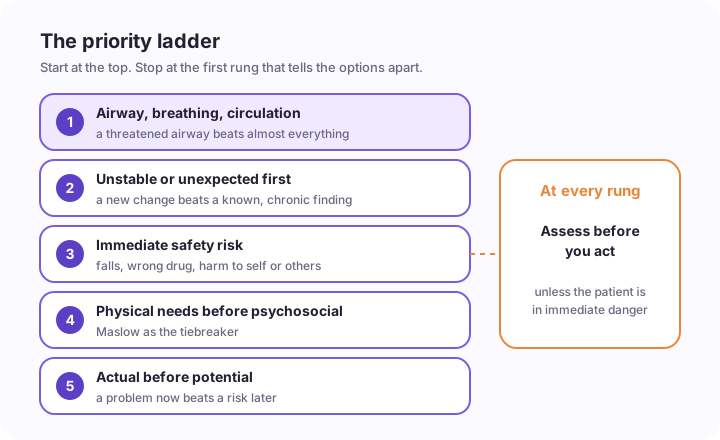
Try it on a typical question:
The nurse receives handover for four patients. Which patient should the nurse see first? A. A patient one day after abdominal surgery rating pain 6 out of 10, due for analgesia in 30 minutes B. A patient with long-standing COPD with an oxygen saturation of 89% on their usual oxygen C. A patient two hours after a thyroidectomy who reports a tight feeling in the throat and a hoarse voice D. A patient with type 1 diabetes whose breakfast tray hasn't arrived
Rung one, airway. Option C describes a possible airway problem after neck surgery. That alone settles it. Option B looks like a breathing problem, but rung two explains why it isn't the priority: a saturation in the high 80s is often the expected target for a patient with chronic COPD, and nothing in the stem says it has changed. Option D matters, and you'll sort out the insulin and the tray soon. Option A is real pain with a plan already in place.
The pattern to notice is that the stem gave you one patient with something new and unexpected in the ABCs. Exam writers build these questions around exactly that contrast: one acute change hiding among chronic or expected findings.
Delegation: tasks move, judgement doesn't
Delegation questions test scope of practice. The US exam talks about unlicensed assistive personnel (UAP) and licensed practical nurses (LPN). In Australia the closest roles are assistants in nursing and enrolled nurses, though scope differs by state and workplace, so learn the version your course teaches.
The rule that answers most of these questions: you can hand over a task, but not the thinking. The registered nurse keeps:
- the initial assessment, and any assessment of a change
- patient teaching, especially new teaching
- evaluating whether care worked
- care of an unstable or unpredictable patient
Tasks that are routine, have a predictable outcome and are for a stable patient can usually be delegated. Taking vital signs on a stable patient, helping someone walk to the bathroom, recording intake and output, and basic hygiene all fit.
Behind that sits the framework most programs teach, the five rights of delegation: the right task, under the right circumstances, to the right person, with the right direction and communication, and with the right supervision and evaluation. A delegation that fails any one of them is wrong, and many questions are really asking which right was broken.
One trap comes up again and again. An assistant reports that a stable patient now "doesn't look right" or has a new abnormal reading. The answer is almost never to ask the assistant to recheck it. The situation has changed from a task to a judgement, so the registered nurse goes and assesses.
Safety: assess first, unless it's an emergency
A lot of "what should the nurse do first" questions are won by one habit. When an option says to assess (check the airway, take a set of observations, look at the IV site), it usually beats an option that acts on an assumption. You confirm before you intervene.
The exception is immediate danger. If the patient isn't breathing, is bleeding heavily or is about to fall, you act, then assess. The skill is noticing which situation the stem describes.
Two more habits help on safety questions:
- Do what you can before you call. An option to notify the provider is usually wrong if there's something within your scope you should do first (sit the patient up, apply oxygen as ordered, stop the infusion). It's right when the problem needs an order or skill you don't have.
- Prefer the least restrictive option. For a confused patient pulling at lines, restraints come after reorientation, supervision and other measures, not before.
Select all that apply and the newer formats
Select all that apply questions punish the wrong instinct, which is to compare options with each other. Treat each one as its own true or false question against the stem. "Is this an expected finding in a patient with left-sided heart failure?" Yes or no, then move on.
The current NCLEX also uses newer item types built on the NCSBN's clinical judgement model, including case studies, matrix grids and bowtie items, and some of them can earn partial credit. The same ladder and the same delegation rule apply inside each one. The NCSBN publishes examples of each format, and it's worth seeing them before exam day so the layout isn't a surprise.
How to practise so it sticks
Answering questions is the practice. The recall over rereading principle holds here more than anywhere: reading a list of priority rules feels like progress, but you only build the judgement by applying it again and again.
After each question, say why each wrong option is wrong. In a priority question, name the rung that ruled it out. In a delegation question, name the right that was broken. I covered why this works in how to study for multiple choice exams: every good distractor you rule out is another small act of retrieval.
Then keep the content side moving, because the ladder only helps if you can recognise a red flag when you see one. My post on studying for nursing exams covers learning each condition as a chain from cause to action.
If you'd like questions built from your own lectures, upload a week's slides to The Study Mill. It writes a quiz from that week's material, mixing multiple choice with written answers that it marks, and the written ones are a good place to practise explaining why one patient comes first. Try it on one lecture and see if the questions match what your unit is testing.
This is general study advice, not clinical guidance or official exam information. For current NCLEX formats and rules, check the NCSBN candidate bulletin, and follow your program and clinical educators for practice.