Metoprolol, atenolol, propranolol, bisoprolol. Open a first pharmacology lecture and it can feel like someone tipped a bag of Scrabble tiles onto the slides. Most students respond by making one flashcard per drug and grinding through a few hundred of them. It works, slowly, and then half of it is gone by the exam.
There's a shorter road. Most modern drug names are built to be decoded: the ending tells you the class. So you learn the class once (what it does, the big side effects, what you check before giving it), learn one prototype drug really well, and then any new name with that ending slots straight in. Review it in short spaced sessions and you'll be learning dozens of families, not hundreds of strangers.
Why the endings work
Generic drug names aren't random. The World Health Organization runs the International Nonproprietary Names (INN) system, and it assigns shared "stems" to drugs that belong together. Every drug ending in -olol is a beta blocker. Every -pril is an ACE inhibitor. That's deliberate, so prescribers can recognise a drug's family from its name.
In Australia this matters even more than it used to. Since February 2021, most PBS prescriptions have had to list the active ingredient rather than leading with a brand, so the generic name is the one you'll see on charts and scripts. Learn the generic, and treat brand names as extras your course might ask about.
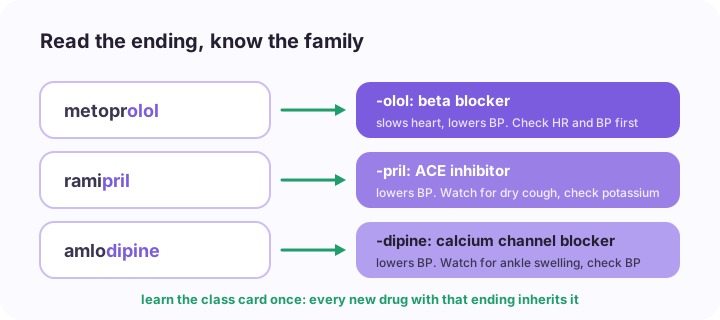
Some of the stems you'll meet in a first-year course:
| Ending | Class | Examples |
|---|---|---|
| -olol | Beta blockers | metoprolol, atenolol |
| -pril | ACE inhibitors | ramipril, perindopril |
| -sartan | Angiotensin II receptor blockers | candesartan, irbesartan |
| -dipine | Calcium channel blockers | amlodipine, felodipine |
| -statin (strictly -vastatin) | Cholesterol lowering (HMG-CoA reductase inhibitors) | atorvastatin, rosuvastatin |
| -prazole | Proton pump inhibitors | pantoprazole, esomeprazole |
| -azepam | Benzodiazepines | diazepam, lorazepam |
| -cillin | Penicillins | amoxicillin, flucloxacillin |
| -floxacin | Fluoroquinolone antibiotics | ciprofloxacin, moxifloxacin |
| -terol | Beta-2 agonist bronchodilators | salmeterol, formoterol |
Your course decides which classes matter, so build your own version of this table from your lecture slides rather than memorising mine.
The method, step by step
1. Learn the class before the drug
For each class, write one card that answers four questions:
- How does it work? One sentence, in your own words.
- What is it used for?
- What are the side effects that get tested?
- What do you check before and after giving it?
For beta blockers that might be: they slow the heart and lower blood pressure, they're used for hypertension, angina and some arrhythmias, watch for bradycardia and hypotension, and check heart rate and blood pressure before you give a dose. Every -olol you meet afterwards inherits that card.
2. Pick one prototype per class and know it cold
Choose the drug your lecturer mentions most. Learn it in more detail: typical route, any important interactions, what you'd teach the patient. When an exam question names a different drug from the same class, you reason from the prototype. That's far more reliable than hoping you remember a card you saw once.
3. Then learn the exceptions on purpose
Stems only cover part of the formulary. Plenty of older or important drugs don't follow a pattern: digoxin, warfarin, morphine, furosemide, metformin. Some endings are also less tidy than the table suggests, and a few drugs within a class behave differently from their siblings. Keep a separate "doesn't fit" deck. It'll be smaller than you fear, and because these drugs stand out, they're often easier to remember.
4. Watch for look-alike, sound-alike pairs
Hospitals keep lists of drug names that are easy to confuse, like hydralazine and hydroxyzine. These are a medication safety issue, not just an exam one, and they're a favourite for tricky multiple choice options. Put confusable pairs on the same card and make yourself say what's different about them.
5. Test yourself in both directions
Recognising "amlodipine" when you see it is the easy half. The exam will also give you a patient with a problem and ask which drug fits, or give you a side effect and ask which class caused it. So quiz yourself both ways: name to class and use, and situation back to drug. Retrieval practice like this beats rereading by a wide margin in learning research, and it's the habit that carries over to clinical questions. Why recall beats rereading.
6. Space it out
Pharmacology is a lot of material that has to last, which is exactly what spaced repetition is for. Ten or fifteen minutes a day, with the cards you miss coming back sooner, will keep more in your head than one long Sunday session. If you want a schedule you can run without an app, use the spaced repetition ladder.
A note on mnemonics
Mnemonics are worth using for small, stubborn lists, like the side effects of a single drug that refuse to stick. They're a poor fit for the whole subject. Stems and class cards give you a structure that grows; a mnemonic per drug gives you three hundred little rhymes to forget. Use them as patches, not as the system.
Where The Study Mill fits
I build The Study Mill, so weigh this accordingly. If your pharmacology unit comes as lecture slides, you can upload each week and it'll write flashcards and a quiz from those slides specifically, so the drugs and classes match what your lecturer covered, not a generic list. The quiz mixes multiple choice with written answers that are marked for you, which is useful for the "explain why you'd hold this dose" type of question. Questions you miss come back in daily review. Walk & Learn turns the week into audio, with Milli and Luke asking you questions out loud, which suits a drive to placement.
It doesn't replace an official drug reference, and it won't decide which drugs matter for your course. Your unit outline does that. If you'd rather build every card by hand, Anki is excellent for this, and I compare a few options in Quizlet alternatives for nursing students. The free plan covers 2 classes, which is enough to try it on pharmacology alongside one other unit.
A weekly rhythm for pharmacology
| When | What | Time |
|---|---|---|
| After the lecture | Add new classes to your stem table, write class cards | 20 min |
| Daily | Review due cards, both directions | 10 to 15 min |
| Weekly | Quiz on the week's drugs, redo misses | 20 min |
| Before the exam | Scenario questions across all classes, mixed together | 30 min a day |
If you only change one thing this week, take your next pharmacology lecture and sort every drug on it by its ending before you make a single flashcard. You'll probably find the list is a lot shorter than it looked.
This is general study advice, not clinical guidance. Always check doses, indications and nursing considerations against your course materials and an approved drug reference such as the Australian Medicines Handbook.