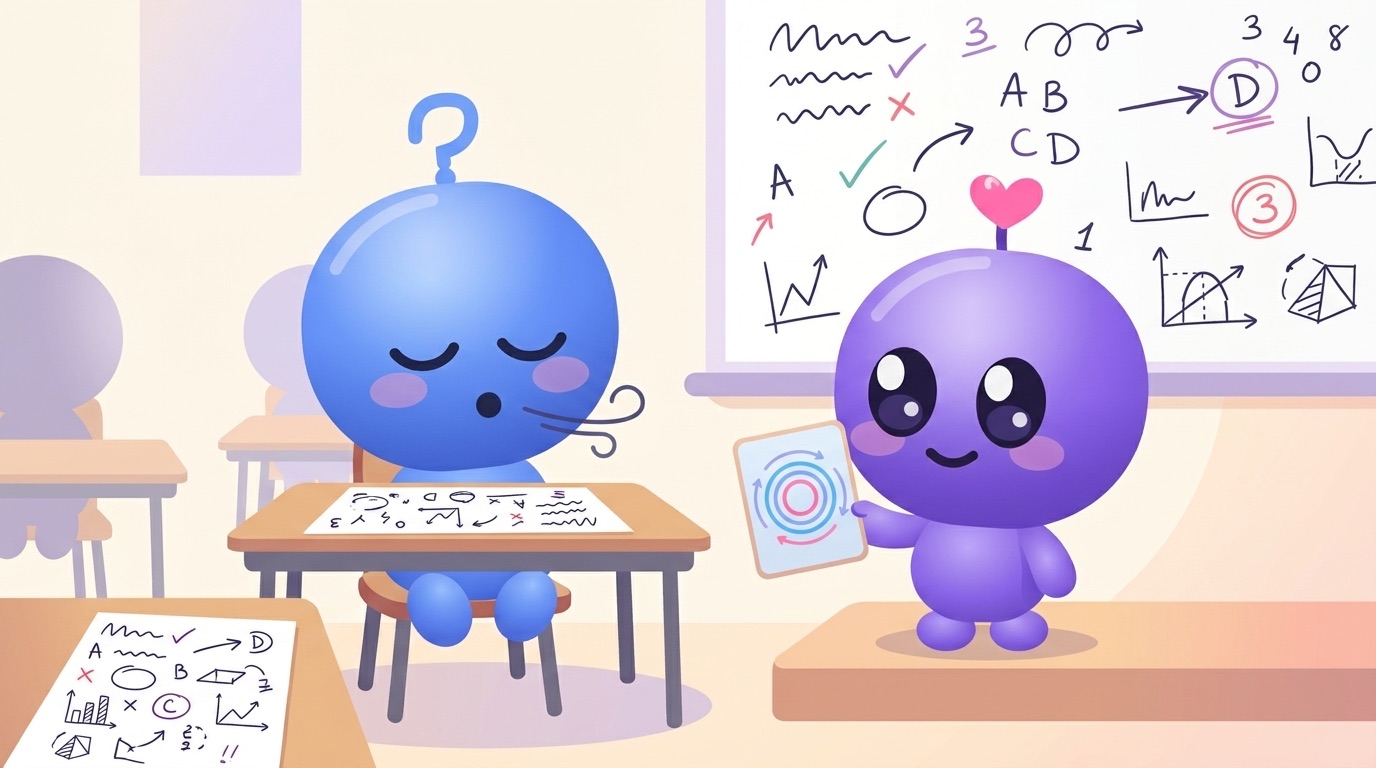
You turn the page, read question 4, and nothing comes. You know you studied this. You can picture the slide. But the answer is gone, your heart is going, and now you're also thinking about the clock, the person scratching away next to you, and what happens if you fail.
When your mind goes blank in an exam, the knowledge hasn't disappeared. Stress is getting in the way of pulling it out. So the fix in the moment is to slow your body down for about a minute, then go around the question instead of straight at it: write anything related, move on, and come back. The longer fix happens before exam day. Study by testing yourself, because memories you've practised retrieving hold up much better under pressure than ones you've only reread.
I build The Study Mill, so I'm biased about tools. Nothing below needs an app.
Why your mind goes blank
Exam stress isn't imaginary and it isn't a character flaw. When you feel threatened, your body releases stress hormones that get you ready to act. That's useful for running. It's less useful for recalling the stages of the cardiac cycle, because the same response interferes with retrieving things from memory.
Worry adds a second load. Research on test anxiety, especially Sian Beilock's work on "choking", suggests that anxious thoughts take up working memory, the limited mental space you use to hold and juggle information while you answer. Part of your head is solving the problem. The other part is running "what if I fail" on a loop.
So a blank is usually a retrieval problem, not a knowledge problem. That's good news, because retrieval problems can be worked around.
The first 60 seconds
When it happens, don't keep staring at the question. Staring tends to make it worse.
- Put the pen down and breathe out slowly. Breathe in through your nose for about four counts, then out for longer, about six. Do it five or six times. A long out-breath is one of the most reliable ways to calm your body quickly, and nobody in the room will notice.
- Name it. Say to yourself, "this is a blank, it's stress, it passes."
- Unclench. Drop your shoulders, loosen your jaw, put both feet flat on the floor.
Go around the question, not through it
Now you can get the answer back by a side door.
- Write down anything connected. A diagram, a keyword, the lecture it came from, a related drug, a case name. For a nursing student stuck on a heart failure question, that might be a sketch of the heart with arrows. For a law student it might be the name of the case you half remember. Memory works by association, and one cue often pulls the rest out.
- Skip it and come back. Mark it and move on to a question you can do. Answering something you know settles your nerves and banks marks. Very often the blanked answer turns up while you're working on something else, sometimes because a later question jogs it.
- Read the question again, slowly. Panic makes you skim. Underline what it's actually asking. Sometimes the blank was really "I misread it".
- Write a partial answer. On short answer and essay questions, markers can give part marks for a correct start. A blank page gets nothing.
Reframe the racing heart
Your heart is pounding and your hands feel shaky. The instinct is to read that as "I'm not ready". There's decent research suggesting a different reading helps.
In a study by Jeremy Jamieson and colleagues, students preparing for the GRE (an American graduate entry test) were told before a practice test that feeling aroused before a test is normal and can help performance. They did better on the maths section than students who weren't told this, and the difference showed up again in their real GRE scores later. The racing heart was the same. What changed was what they thought it meant.
So when you feel it, try "my body is getting ready" instead of "I'm panicking". It isn't magic. It's a better story than the one stress tells you.
Ten minutes before you walk in
One of the better-known findings in this area comes from Gerardo Ramirez and Sian Beilock, published in Science in 2011. Students who spent about ten minutes before an exam writing openly about their worries did better than students who didn't, and the effect was strongest for the most anxious students. The idea is that putting the worry on paper frees up some of that working memory.
You can do a version of this outside the exam room. Write down what you're worried about, plainly, then throw the page away. Don't use those ten minutes to cram a new topic. I made the same point in how to study the night before an exam: new material at the last minute mostly adds panic.
The real fix happens weeks earlier
The in-the-moment tricks help. The biggest protection is how you studied.
In 2016, Amy Smith and colleagues at Tufts published a study in Science comparing students who learned material by rereading it with students who learned it by testing themselves. Then they put some of them through a stressful task before a memory test. The rereading group remembered less under stress. The practice testing group didn't show that drop. It's one study and the researchers were careful not to oversell it, but it fits a much larger body of research showing that retrieval practice builds memories that are easier to find.
That makes sense. If the first time you try to pull an answer out of your head is in the exam hall, under stress, of course it's hard. If you've pulled it out twenty times in practice, the path is worn in. I've written more about this in active recall vs rereading.
A few habits that make exam day calmer:
- Practise under exam conditions at least once. Timed, no notes, phone in another room. The exam then feels familiar instead of new.
- Practise skipping. In practice papers, train yourself to move on after a minute stuck. It's a skill, and it's easier to use on the day if you've rehearsed it. For multiple choice specifically, my post on how to study for multiple choice exams covers when to change an answer.
- Sleep. A tired brain is worse at retrieval and worse at managing stress. An all-nighter makes blanks more likely, not less.
When it's more than nerves
Some nerves before an exam are normal and even useful. If anxiety is stopping you from sitting exams, or blanks happen in every exam no matter how well you prepare, talk to your university's counselling or student wellbeing service. They see this every semester, and many universities can arrange exam adjustments if anxiety is affecting you.
Where The Study Mill fits
The most useful thing an app can do here is give you lots of retrieval practice from your own course before exam day. The Study Mill turns your lecture slides, notes or recordings into a quiz that mixes multiple choice and written answers marked by AI, plus flashcards and short lessons, all from your material. Questions you miss come back in daily review, so you meet the tricky ones many times before the exam does. The free plan covers 2 classes.
To be fair, any self-testing works. Past papers, flashcards you write yourself, or a friend quizzing you over coffee all do the same job.
If your next exam is coming up, upload one lecture and test yourself on it tonight. Then, if your mind goes blank on the day: breathe out slowly, write anything connected, and move on. It usually comes back.
This is general study advice, not medical or clinical guidance. If anxiety is affecting your health or your exams, contact your university's counselling service or a GP.