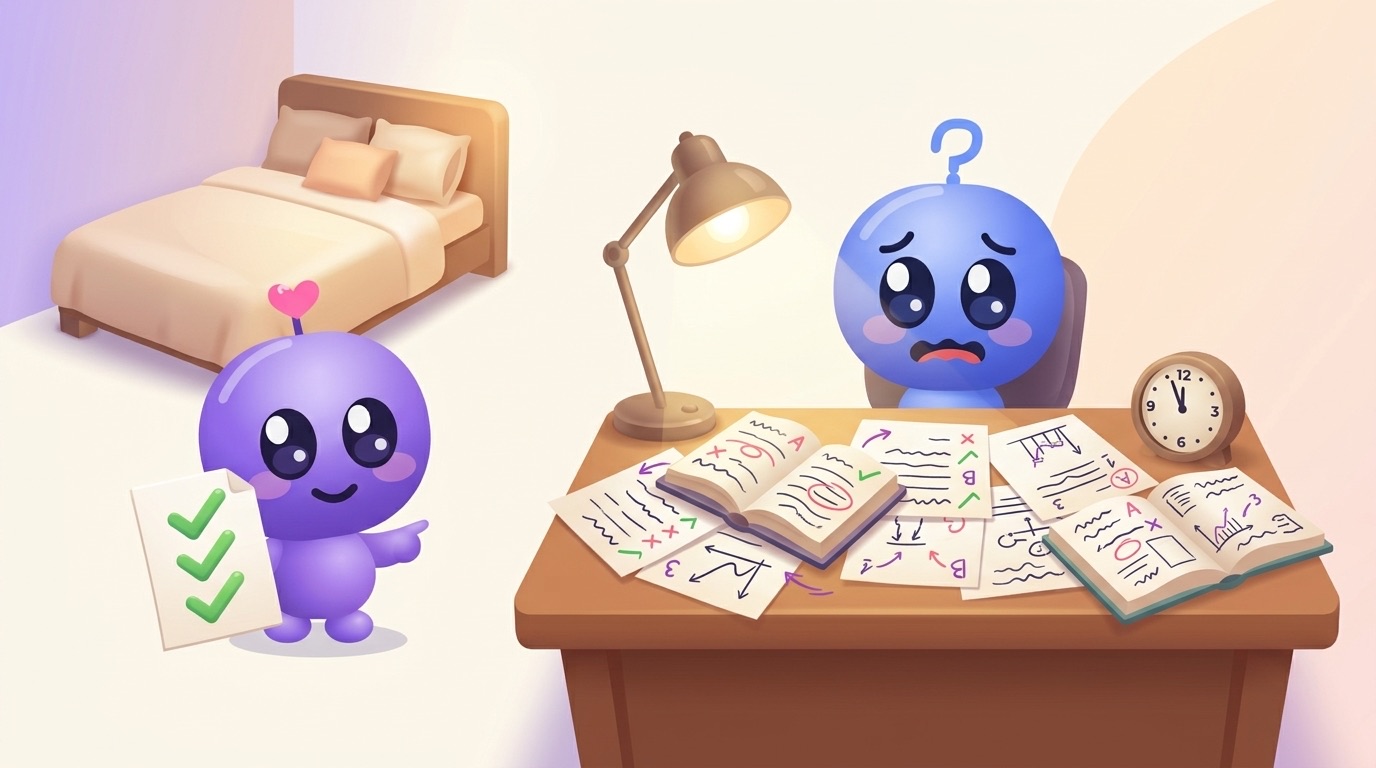
It's 8pm. The exam is at 9am. You open the unit page and there are twelve weeks of lecture slides you have mostly not read. Your first instinct is to start at week one and read as fast as you can until you run out of night.
Don't. With one evening, you can't learn the whole unit, so stop trying. Spend the night on the topics most likely to be examined, test yourself on them rather than rereading, write a one-page cue sheet of what you keep getting wrong, and go to bed at a normal time. A few hours of focused practice questions and a full night's sleep will get you more marks than an all-nighter spent reading slides.
I build The Study Mill, so I'm biased about the tools. The plan below works with paper and a pen.
First, accept the trade
The hardest part of the night before is letting go of the material you won't cover. Every minute you spend on a week-one topic that's worth two marks is a minute you're not spending on the topic that's worth twenty.
So the goal for tonight isn't "know everything". It's "pick up as many marks as possible in the time I have". That changes what you do.
Step 1: Triage (30 minutes)
Before you read a single slide, work out where the marks are. Look at:
- The exam format. Multiple choice, short answer, essays, case studies? A law exam built on problem questions needs different practice from a pharmacology exam full of multiple choice.
- Past papers and practice exams, if your unit has them. Topics that come up every year will probably come up again.
- Learning objectives in the unit outline. Exams are usually written against these.
- Anything the lecturer flagged. "This will be on the exam", review lectures, the slides they spent three weeks on.
From that, make a short list: the five to eight topics most likely to be worth the most marks. Rank them. You'll work down the list and stop when you run out of time. Anything not on it gets a quick skim at the very end, if at all.
For a nursing student, that might mean the medication safety and assessment content before the history of the profession. For a psychology student, it might mean research methods before the one lecture on a niche theory.
Step 2: Test yourself, topic by topic (most of the evening)
For each topic on your list, in order:
- Try the questions first. Past paper questions, the tutorial questions, or questions you write from the learning objectives. Answer from memory, even if your answer is bad.
- Check, then look up only what you got wrong. Now open the slides, for the gaps only.
- Try again without looking. If you can explain it now, move on. If not, mark it for your cue sheet.
This feels slower and worse than reading. It isn't. Decades of research on the testing effect show that pulling an answer out of memory makes it stick better than looking at it again, especially once there's a gap (like a night's sleep) before you need it. Rereading feels productive because the page looks familiar, but familiar isn't the same as being able to produce the answer in an exam hall. I've written more about that trap in active recall vs rereading.
Testing also does something rereading can't: it tells you exactly what you don't know, while there's still time to fix it.
If you've got no questions to work from, make them. Turn each heading in the slides into a question ("What are the stages of wound healing?") and answer it before you read the slide. A chatbot can write practice questions for you too, but check them: AI quizzes often give the answer away by its length or position.
Step 3: One page of cues (30 minutes)
By now you'll have a pile of things you got wrong twice. Put them on one page, written as prompts rather than answers: "Warfarin: antidote? what do we monitor?" rather than a copied paragraph. That page is what you look at over breakfast.
I've written a whole post on building a cram sheet that works, so I won't repeat it here. The short version is that if it's longer than a page, you're copying rather than choosing.
Step 4: Stop, and sleep
This is the step people skip, and it's the one that matters most.
Sleep is when your brain consolidates what you learned during the day. Research on sleep deprivation consistently finds that going without sleep hurts memory, attention and reasoning, which are the exact things an exam tests. An all-nighter means you'd sit the exam tired, slower to recall, and more likely to misread a question. Students who regularly pull all-nighters also tend to do worse overall.
So set a hard stop. Work backwards from when you need to wake up, give yourself a full night, and finish studying an hour or so before that. Put the phone away. If you're lying in bed running through your cue sheet in your head, that's fine. That's retrieval practice too.
One honest caveat: one good night of sleep can't make up for a semester without much of it. The night before is about protecting what you've got, not a magic fix.
The morning of the exam
- Eat something.
- Run down your cue sheet once, answering each prompt in your head. Ten minutes, not two hours.
- Don't learn anything new. A brand new topic at 7am mostly adds panic.
- Get there early, read every question carefully, and start with the ones you know to bank marks and settle your nerves.
A rough timetable for a 9am exam
| Time | What you're doing |
|---|---|
| 7:30pm to 8:00pm | Triage: exam format, past papers, objectives, ranked topic list |
| 8:00pm to 10:30pm | Test yourself on topics in order, fixing gaps as you go, with a short break each hour |
| 10:30pm to 11:00pm | Write the one-page cue sheet |
| 11:00pm | Stop. Wind down, bed |
| Morning | Breakfast, one pass of the cue sheet, leave early |
If you started later, shrink step 2, not the sleep.
Where The Study Mill fits
If you've got your lecture slides or notes as files, The Study Mill (which I build) will turn a week into a quiz, flashcards and short lessons drawn from that material, which takes care of the "I have no questions to practise with" problem. The quiz mixes multiple choice and written answers marked by AI, and anything you miss comes back in daily review. The free plan covers 2 classes, which is enough for a night like this.
To be fair, past papers from your own unit are better than anything an app can write, because they're written by the person who writes your exam. If you have them, start there.
And if you'd rather not be here next semester, the fix is boring: a little spaced practice each week. My finals week study schedule is a good place to start.
For tonight, though: pick your topics, test yourself, write one page, and sleep. If you want somewhere to get practice questions fast, upload your heaviest lecture and see what comes back.
This is general study advice, not medical or official guidance. If illness, a crisis or a clash is affecting your exam, check your university's special consideration policy.