
Most finals schedules fail on day two. They're written on the first night in a burst of optimism: eight hours a day, every day, hardest subject first. By Tuesday it's off track, and by Wednesday you've stopped looking at it.
A schedule that survives starts from the hours you really have, not the ones you wish you had. You list the exams, count your real study time, give each subject time by how much it's worth and how weak you are, and spread every subject across several days. Every block is practice questions, not rereading.
1. Write down the real constraints
- Every exam, with its date and time
- Shifts, placements and any classes still running
- The things you won't skip: sleep, meals, the gym, your nan's birthday
Be honest here. A plan built around imaginary hours fails the first time real life turns up.
2. Count your blocks
Split your free time into blocks of 45 to 90 minutes with breaks between. Most people get four to six properly focused blocks a day in exam season. Past that, quality falls off a cliff and you're just sitting at a desk.
3. Decide how much each subject gets
Score each subject from 1 to 3 on two things:
- Weight: how much it counts. A 60% final beats a 20% quiz.
- Weakness: how shaky you are on it.
Multiply them. A subject scoring 9 gets about three times the blocks of one scoring 3.
4. Spread subjects out
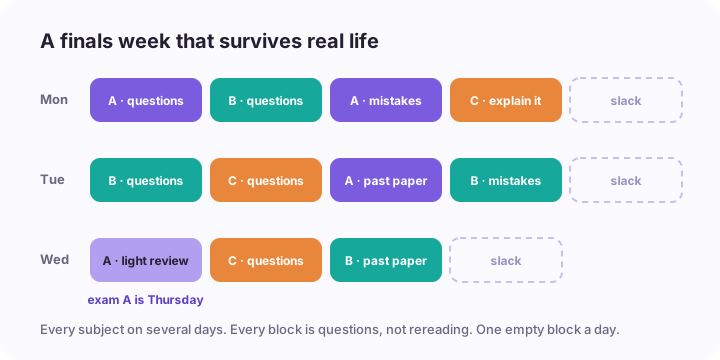
It's tempting to do "Monday is Anatomy, Tuesday is Pharmacology". Don't. Give each subject a block or two on several different days. Coming back to a topic after a gap, and mixing related subjects, both lead to better recall than one marathon. Why spacing works.
The last session for any subject should be the day before its exam, and short: a review, not new learning.
5. Decide what each block is for
"Study Anatomy" isn't a plan. "20 questions on the cardiovascular system, then redo the ones I miss" is. Good block types:
- Practice questions on one topic
- Redo your mistakes from earlier sessions
- Explain it out loud with no notes, then check
- A past paper under timed conditions, a few days before the exam
Rereading and highlighting should be close to zero. Why.
6. Leave slack
One empty block a day. Something will run over, a topic will be harder than you thought, or you'll need a break. A schedule with no slack breaks the first time anything goes wrong.
A template
Or let something build it
If you'd rather not do this by hand, The Study Mill (which I build) asks for each class's exam date and plans revision across the days you're free, around your timetable and any days you block out, using the weeks you've already uploaded. Miss a session and it replans the rest.
The night before each exam
Light review only: your cram sheet, a few practice questions, then bed. Sleep is when memories consolidate, and an all-nighter usually costs more than it gains.
More: how to study for nursing exams · spaced repetition explained