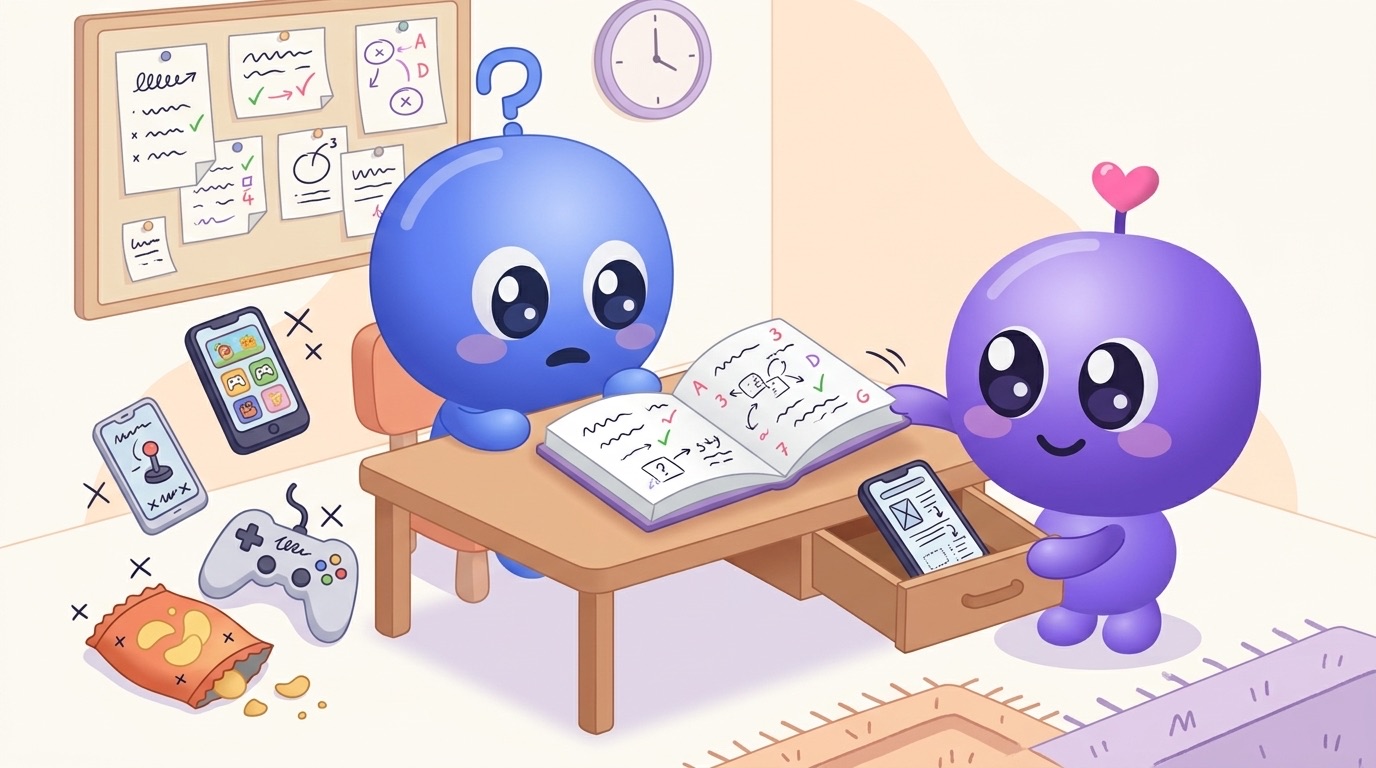
You sit down to do the week 8 microbiology lecture. You open the slides, read the title, and pick up your phone "for a second". Twenty minutes later you've tidied the desk, made a snack, answered three group chats and reorganised your Notion. The slides are still on slide one.
Procrastination usually isn't a time management problem or a character flaw. It's mostly a way of escaping a bad feeling. The task makes you feel confused, bored or worried, and the phone makes that feeling go away for a minute. So the fix isn't more willpower. It's changing the setup: make the first step clear enough that it stops feeling vague and heavy, make the escape a bit harder to reach, and when you do slip, forgive yourself quickly instead of stewing in it, because the guilt is what makes tomorrow's start even harder.
Why you put it off (it's not laziness)
Researchers who study procrastination, including Fuschia Sirois and Tim Pychyl, describe it as a problem of short-term mood repair. When a task makes us feel bad, putting it off makes us feel better right now. The cost lands on future you, who has less time and the same lecture.
That's why it feels so irrational from the inside. You know the quiz is Friday. You care about your nursing degree. But in the moment, the choice isn't really "study or don't study". It's "feel uncomfortable or feel fine", and feeling fine wins a lot.
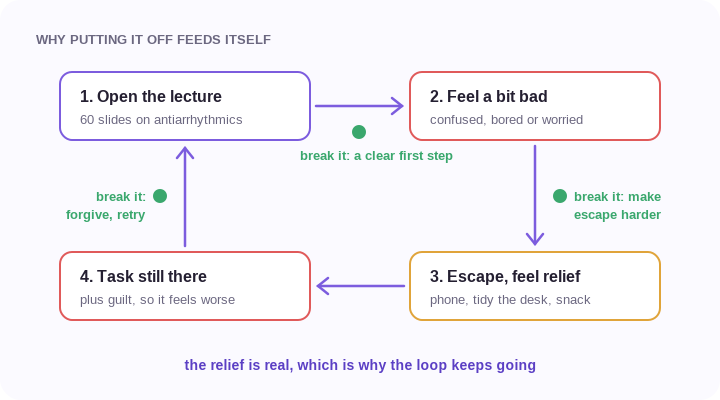
The loop feeds itself. Every escape works, so your brain learns that escaping works. And every time you come back, the task has picked up a layer of guilt on top of the original discomfort. That's how one avoided lecture turns into three.
The useful part is that each step of that loop is something you can change without having to feel any different first.
Name the feeling, then fix that one
"I'm procrastinating" is too general to act on. Ask what the task makes you feel when you open it. It's usually one of a few things, and each has its own fix.
| When you open it, you feel... | What's going on | Try this |
|---|---|---|
| Lost: "I don't know where to start" | The task is vague | Write the very next action, like "answer the 4 questions on slide 12" |
| Bored: "this is so dry" | Low reward, no feedback | Switch from reading to answering questions |
| Worried: "I won't understand it" | Fear of finding out | Do 3 easy questions first to get a foothold |
| Overwhelmed: "there's too much" | Too many weeks behind | Pick one lecture and ignore the rest for today |
The lost and overwhelmed ones are about task size, and I've written a whole post on shrinking a task until it's small enough to start in how to study when you have zero motivation. The bored one is worth a closer look, because the most common way to study is also the most boring.
Rereading slides gives you almost nothing back. You can't tell if it's working, so it feels pointless, and a task that feels pointless is easy to escape. Answering questions is different. Each one gives you a small result, right or wrong, and that's a lot more engaging. It also helps you remember far more, which I covered in active recall vs rereading.
Make the escape a little harder
This is the bit that doesn't need any willpower at all. You don't have to resist your phone if your phone isn't there.
The idea is friction. The easier something is to reach, the more often you'll reach for it. You can use that both ways:
- Add steps between you and the distraction. Phone in a drawer or another room, not face down on the desk. Log out of the sites you drift to, so getting back in takes a password. Close every tab except the lecture.
- Remove steps between you and the study. Have the slides already open when you sit down. Leave tomorrow's quiz loaded on your laptop tonight. Keep the flashcards on the home screen where the social apps used to be.
Charging your phone in the kitchen during a study block sounds too simple to matter. It works because getting up and walking to the kitchen gives you a few seconds to notice what you're doing, and that's often enough to sit back down.
If you need a clear end point to agree to, a timer helps here too. Committing to one 25-minute block with the phone in another room is a much easier promise than "study all afternoon". The Pomodoro technique post covers when that works and when it gets in the way.
Watch out for productive procrastination
Some escapes look like study. Colour-coding your timetable. Rewriting last week's notes neatly. Researching the best note-taking app. Watching a YouTube explainer on a topic you haven't opened the slides for yet.
None of these is bad on its own. The test is simple: at the end of it, could you answer more questions about the lecture than before? If not, it was a nicer-looking version of scrolling. Notice it, then go back to the one next action you wrote down.
Forgive yourself, then start again
This sounds soft, but there's interesting research behind it. In a study of first-year university students, Michael Wohl, Tim Pychyl and Shannon Bennett found that students who forgave themselves for procrastinating before their first set of exams tended to procrastinate less before the next set. The link seemed to run through bad feelings: forgiving yourself took some of the negative emotion away, so the task was less unpleasant to come back to.
It was a correlational study, so it doesn't prove that deciding to forgive yourself will fix things. But it fits the loop. If the guilt makes the task feel worse, beating yourself up just adds fuel.
So when you lose a night to your phone, try something like: "I avoided it because it felt hard. That's normal. Tomorrow at 4 I'll do the first five questions." Then leave it there.
One honest note: everyone procrastinates, but if it's constant, affects everything and not just study, or you've always found it much harder than other people to start things, it's worth talking to your GP or your uni's counselling or disability service. This post is general study advice, not health advice.
Where The Study Mill fits
I build The Study Mill, so I'm biased, but most of it is about taking away the "where do I start?" feeling. You upload a week's slides, notes or a lecture recording, and it becomes short lessons, flashcards and a quiz built only from that material. So the next action is always obvious: open the week and answer the first question. The daily review brings back the ones you got wrong, so there's always a small, clear thing waiting. And on the days the desk itself is the problem, Walk & Learn has Milli and Luke teach the week as audio and ask you questions you answer out loud, so you can put the phone in your pocket and go for a walk instead.
It won't make the discomfort disappear. It just makes the gap between sitting down and doing something small enough that the discomfort doesn't get a chance to win.
Try it on one lecture
Pick the lecture you've avoided longest. Put your phone in another room, open that lecture, and answer five questions on it before you do anything else. If you'd like those questions made from your own slides, upload it to The Study Mill. The free plan covers two classes, and the first five questions take a few minutes.