
It's Tuesday night. The pharmacology quiz is on Friday, the lecture slides have been open in a tab since Sunday, and you've spent forty minutes deciding whether to start. You're not lazy. You just feel nothing, and every time you look at the slides the nothing gets heavier.
Here's the useful thing to know: you don't need motivation to start studying. Motivation usually turns up after you start, not before. So the trick isn't to find the feeling. It's to make the first step so small that you'll do it without the feeling, and to make that step something active, like answering a few questions, so you get a quick sense of progress. Do that, and most nights the motivation follows. On the nights it doesn't, you've still done something.
Why waiting for motivation doesn't work
Most of us treat motivation as the fuel and study as the car. No fuel, no driving. But for a task you don't enjoy, the fuel rarely arrives on its own. Waiting for it is how a Tuesday becomes a Thursday.
Research on procrastination points the same way. In a large review of the procrastination literature, the psychologist Piers Steel found that how unpleasant a task feels is one of the most consistent predictors of putting it off. So is low confidence that you can do it. Notice that neither of those is "not caring enough". You can care a lot about your nursing degree and still dread a 60-slide lecture on antiarrhythmics, because the lecture as a whole feels big, vague and hard.
That's good news, because "big, vague and hard" is something you can change tonight. The amount you care isn't.
Shrink the task until it's too small to refuse
"Study pharmacology" isn't a task. It's a mood. Your brain can't start a mood, so it does something else instead.
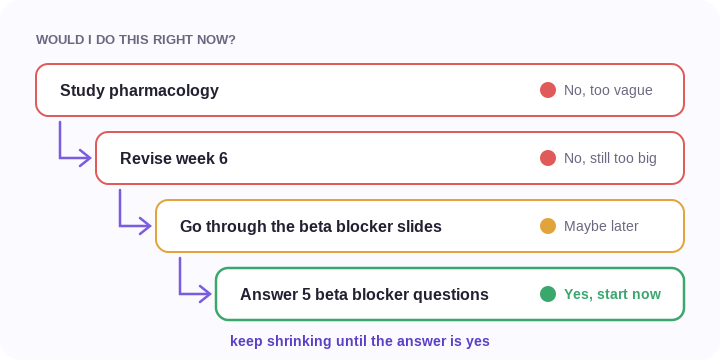
Keep cutting it down until the honest answer to "would I do this right now?" is yes. For most people, that's somewhere around five minutes and one clear action:
- Not "revise week 6", but "answer five questions on beta blockers".
- Not "read the contracts lecture", but "write down the four elements of a valid contract from memory, then check the slides".
- Not "learn the cranial nerves", but "do the first three, out loud, without looking".
Give yourself permission to stop after that one step. You mostly won't. Starting is the expensive part, and once you're in, carrying on is cheaper than stopping and starting again tomorrow. If you do stop, you've broken the run of zero days, which matters more than it sounds.
Make the first step a question, not a page
When you have no energy, rereading feels like the gentle option. It isn't. Rereading gives you nothing back, so after ten minutes you're tired and you have no idea whether anything went in. That makes the next session feel even more pointless.
Answering questions does the opposite. Each one you get right is a small win you can see, and each one you get wrong tells you exactly what to do next. That feedback is a big part of what keeps people going. It's also far better for your memory, which I've written about in active recall vs rereading.
So open with three to five questions from the lecture you're avoiding. If you don't have any, write them from the slide headings, or have an AI make some from your own slides. Get some wrong. Then look up only those.
Decide when and where, in advance
"I'll study tomorrow" almost never happens. "Tomorrow, when I get home from placement and put my bag down, I'll do ten flashcards at the kitchen table" happens a lot more often.
This is called an implementation intention, and it's one of the better-supported ideas in behaviour research. Peter Gollwitzer and Paschal Sheeran pulled together dozens of studies and found that people who make specific if-then plans ("if it's this time and place, I'll do this") follow through on their goals noticeably more often than people who only intend to. The plan does the deciding ahead of time, so the tired version of you doesn't have to.
Write one for tomorrow. One sentence: when, where, and the tiny first step.
Pair it with something you like
Another idea with decent evidence behind it is temptation bundling. In a study at a university gym, Katherine Milkman and colleagues gave people gripping audiobooks they could only listen to while working out, and those people went to the gym more often, at least for a while. The effect faded after a long break, so it's a boost, not a cure.
For study, that might mean your good coffee only at the desk, a favourite playlist only during flashcards, or doing your quiz at the café you like. Keep the treat tied to the study. If you get it either way, it stops pulling you in.
Lower the bar on bad days
Some days you'll have less in the tank than others. Plan for that instead of pretending it won't happen.
| How you feel | Do this |
|---|---|
| Fine, just can't start | One five-minute step, then decide |
| Tired but awake | Flashcards or a short quiz, 15 to 20 minutes |
| Flat and can't sit at a desk | Listen to the week as audio on a walk |
| Completely empty | Write tomorrow's first step down and stop |
A short session done beats a long one skipped. If you want help with how long a good session is, how long should you study for covers it, and the Pomodoro technique is a handy way to agree to just one block.
One honest note. Everyone has flat weeks, especially near the end of semester. But if the low motivation has lasted for weeks, and it's not just study but everything, that's worth talking to someone about. Your GP or your uni's counselling service is a good first stop. This post is general study advice, not health advice.
Where The Study Mill fits
I build The Study Mill, so I'm biased, but a lot of it is designed for exactly these nights. You upload a week's slides, notes or lecture recording, and it becomes short lessons, flashcards and a quiz built only from that material. So the first step is already made for you: open the week, answer a few questions, done. The daily review brings back what you got wrong, so there's always a small, clear thing to do. And on the days you can't face a desk, Walk & Learn has Milli and Luke teach the week as audio and ask you questions you answer out loud while you walk.
It won't make you want to study. Nothing will on some days. It just makes the first five minutes easy enough that wanting to doesn't matter so much.
Try it on one lecture
Pick the lecture you've been avoiding the longest. Write down when and where you'll start tomorrow, and make the first step five questions on it. If you'd like those questions made from your own slides, upload that lecture to The Study Mill. The free plan covers two classes, and five questions is about three minutes.