
It's Sunday, the library opens at nine, and you've promised yourself an eight-hour day on pharmacology. By two o'clock you've reread the same page on beta blockers four times, you've checked your phone more often than your notes, and the hours on the clock look great while the stuff in your head doesn't.
So how long should you study for? For most students, a focused session of roughly 30 to 60 minutes, followed by a short break, works better than a long unbroken stretch. More important than the length of any one session is how you spread them out: several shorter sessions across the week beat one marathon of the same total time. That's one of the most reliable findings in learning research. The total you need depends on the unit, but the shape of it matters more than the number.
What the research actually says
There isn't a magic number of minutes, and anyone who gives you one precisely is overselling. But a few findings are solid.
Spreading study out beats cramming it together. Psychologists call this the spacing effect, or distributed practice. A large 2006 review by Cepeda and colleagues pulled together hundreds of experiments and found the same thing over and over: the same study time, split across separate sessions, leads to better memory on a later test than one long block. They also found the best gap between sessions grows with how long you need to remember something. If the exam is next month, coming back every few days does more than coming back every few hours.
Breaks help, and scheduled ones may help more. A 2023 study at a Dutch university had students do real self-study sessions with different break rules. Students who chose their own breaks tended to study in longer stretches and reported more fatigue and distraction. Students on a fixed schedule of short study blocks with short breaks felt fresher and got through a similar amount of work. It was one study on one day, and later research hasn't all agreed, so treat it as a hint rather than a law.
The "10-minute attention span" is a myth. You'll often hear that students can only concentrate for 10 to 15 minutes. A well-known 2007 review by Wilson and Korn went looking for the evidence behind that number and found very little. Attention does drift, but not on a fixed timer. What keeps you engaged is more about what you're doing than how long you've been doing it.
Testing yourself keeps your mind from wandering. In a lecture study at Harvard, students who were quizzed between short segments of a recorded lecture reported much less mind-wandering than students who just watched. The same thing works when you study alone. A session spent answering questions holds your attention far longer than one spent rereading. I wrote more about that in active recall vs rereading.
Same hours, two ways
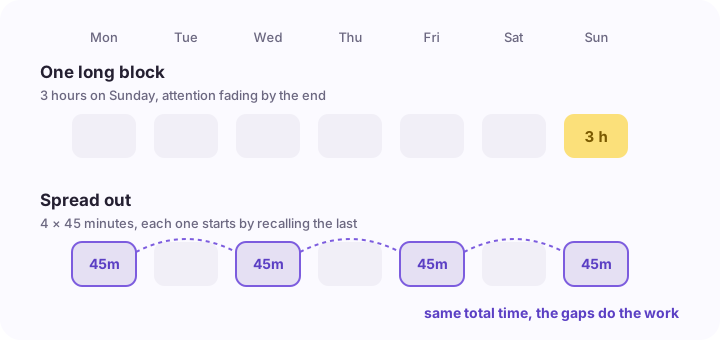
The diagram is the whole argument in one picture. Three hours on Sunday feels productive. Four 45-minute sessions on Monday, Wednesday, Friday and Sunday feels like less, because each one is short and you spend the first few minutes of each struggling to remember last time. That struggle is the useful part. Each time you drag something back out of memory after a gap, it sticks harder. A long single block never gives you a gap to struggle against.
How to pick your session length
Start from the task, not the clock.
Flashcards and quiz questions: 20 to 40 minutes is plenty. Reviewing past that point usually means you're clicking "got it" without really retrieving the answer.
Working problems (drug calculations, stats, accounting): 45 to 60 minutes, because it takes time to get into a problem and you lose that momentum if you stop too early.
Writing or reading for an essay: longer blocks of 60 to 90 minutes can work, since you're building something rather than memorising it. Still stand up and walk around between them.
If you have no idea where to start, try 40 minutes on and 10 off, and adjust. Pomodoro's 25 and 5 is fine too, and it's handy on a day when even starting feels hard. The best signal is your own accuracy: when you start getting easy questions wrong, or you can't remember what you just read, the session is over, whatever the timer says.
What a good day looks like
A full study day can work. It just shouldn't be one block. Something like this suits a lot of people in exam season:
| Block | What you do |
|---|---|
| Morning, 45 min | Quiz on last week's material, mark what you got wrong |
| Break, 10 min | Away from the screen |
| Morning, 45 min | New material from this week |
| Lunch | A proper break |
| Afternoon, 45 min | A different unit, or practice questions mixing topics |
| Late afternoon, 20 min | Redo only the questions you missed this morning |
Four focused blocks adds up to about two and a half hours. That might look small next to the eight-hour plan you started with, but it's often more real study than the eight hours were. Mixing units in the afternoon also gets you the benefits of interleaving.
Sleep counts here as well. Memory gets consolidated overnight, which is part of why spreading study over several days works and why an all-nighter rarely pays off.
How much in total?
This one depends on your unit, your starting point and your exam. A common rule of thumb at Australian unis is around 10 hours a week per full-time unit, including classes, but check your own unit outline, which usually says. What matters more than the total is regularity. Twenty minutes of review most days will carry you further than a heroic weekend once a month. If your exam is close, a two-week exam study plan shows how to lay it out day by day.
Where The Study Mill fits
I build The Study Mill, so I'm biased, but this is exactly why it's organised the way it is. You upload each week's slides or lecture recording, and it turns them into short lessons, flashcards and a quiz you can finish in one sitting. The daily review brings back questions you got wrong, so the spacing happens without you planning it. If you set an exam date, it plans revision around your timetable. Walk & Learn turns a week into audio with two hosts who ask you questions out loud, which makes a 20-minute walk count as a session.
If you'd rather do it all on paper, the same rules apply: short sessions, self-testing, and gaps between them.
Try it this week
Take one lecture you need to know. Instead of one long session on it, do three short ones: today, in two days, and at the end of the week, each starting with questions before you look at your notes. Notice how much is still there on day seven. If you want the questions written for you, upload that lecture to The Study Mill and it'll make them from your own slides. The free plan covers two classes.