Two weeks out is a strange spot. Skipping tonight feels harmless, yet you can already feel the exam on your shoulder. Meanwhile you still have shifts at work, a placement, a sister's birthday dinner and a body that wants to sleep.
Two weeks is plenty of time for one exam, and you don't need to study all day to use it. Aim for three or four focused blocks of about an hour on most days, take two full days off, and spend almost all of your study time answering questions rather than rereading. Bring each weak topic back a few days after you first work on it, and sit two timed practice papers: one at the end of week one to show you what's still missing, one near the end of week two to check you've fixed it. The plan below lays that out day by day.
I build The Study Mill, so I'm biased about tools, but nothing in this plan needs one.
Why two weeks is the sweet spot
My one-week plan works, but it's tight: every day is doing something.
Two weeks gives spacing room to work properly. Memory research has shown for well over a century that studying the same material across several sessions beats one long session, and later studies found that the best gap between sessions grows with how long you need to remember the material. For an exam a couple of weeks away, gaps of a few days between reviews of a topic are about right. If you want the longer version, I go through it in spaced repetition, explained simply.
The extra week also buys you rest. A plan with days off isn't a soft plan. It's one you'll still be following on day 11.
Before day 1: count your real hours
Write down every shift, class and commitment you won't drop for the next fourteen days, then decide how many study blocks each day really holds. On a day with an eight-hour shift, that might be one block on the bus home. On a free Saturday, four.
Don't plan for more than four or five blocks on any day. Past that, most people are sitting at a desk rather than learning.
Week one: find the gaps and start filling them
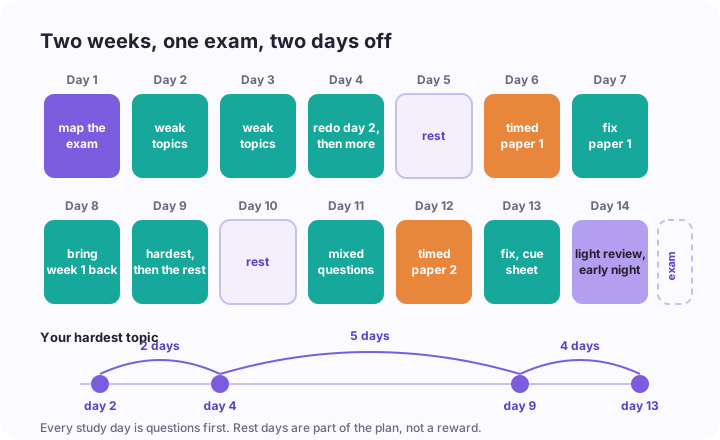
Day 1: map the exam. Find out the format, the weighting of each topic, and every past paper or practice set your unit gives you. Then do an hour of practice questions cold, with no notes, and rank topics by how much they're worth and how shaky you were. That ranked list drives the rest of the fortnight.
Days 2 and 3: heavy, weak topics. Take two or three topics a day from the top of your list. For each one, try the questions first, check your answers, open the slides only for what you got wrong, then close them and try again. Anything you still can't do goes on a running mistakes page.
Day 4: bring day 2 back, then keep going. Redo the day 2 questions you missed before looking anything up. It will feel harder than two days ago, and that effort is what makes it stick. Then carry on down your list.
Day 5: rest. A whole day off, no flashcards on the train. Move it to a different day if that suits your week, but don't delete it.
Day 6: first timed paper. A full past paper or long practice set, timed, no notes, phone in another room. Mark it honestly.
Day 7: fix the paper. Work through every mistake from day 6, questions first again, plus anything left on your mistakes page.
Week two: bring it back and test it again
Day 8: bring week one back. Redo the day 3 questions you missed, then do a short set on each topic from days 2 to 4. Anything that faded goes back on the list.
Day 9: the hardest topic, again, then whatever's left. Your worst topic from day 2 comes back for a third round. Then cover the lower-ranked topics you haven't touched yet, quickly. Some low-value topics may never get a session, and that's a fair trade.
Day 10: rest. Second full day off.
Day 11: mixed questions. Shuffle questions from all your main topics together instead of doing one topic at a time. Real exams don't arrive sorted, so practising this way makes you work out which idea a question is testing, which is often the hard part.
Day 12: second timed paper. A different paper from day 6. If you only had one, build a mock from practice questions you haven't seen. Mark it and compare.
Day 13: fix and condense. Work through day 12's mistakes, then do your hardest topic one last time. Finish with a one-page cue sheet of the things you keep getting wrong, written as prompts ("Metabolic acidosis: what does the body do to compensate?") rather than copied paragraphs.
Day 14: light review and an early night. Run through the cue sheet, do a short mixed set, check the exam room and time, then stop. Sleep is when the brain consolidates what you learned, and losing it reliably hurts memory and attention the next day.
The fortnight at a glance
| Day | Focus | Blocks |
|---|---|---|
| 1 | Map the exam, cold diagnostic, ranked list | 3 |
| 2 to 4 | Weak topics, questions first | 3 to 4 |
| 5 | Rest | 0 |
| 6 to 7 | Timed paper one, then fix it | 3 |
| 8 | Bring week one back | 3 |
| 9 | Hardest topic again, remaining topics | 3 to 4 |
| 10 | Rest | 0 |
| 11 | Mixed questions | 3 |
| 12 to 13 | Timed paper two, fix, cue sheet | 3 |
| 14 | Light review, early night | 1 to 2 |
When life gets in the way
Something will go wrong. A shift runs late or you come down with a cold. When you lose a day, don't double the next one. Slide everything along by a day and take the time out of the lowest-ranked topics on your list. If you lose more than two days, drop the second rest day before you drop the second timed paper.
If you have several exams in the same fortnight, this plan won't fit on its own. Use my finals week study schedule to share the blocks between subjects, and run a cut-down version of these steps inside each subject's share.
Where The Study Mill fits
The part of this plan most students run short on is good questions. If your slides or notes are files, The Study Mill turns each week you upload into short lessons, flashcards and a quiz drawn from that material, with written answers marked by AI. Questions you miss come back in daily review, which handles the bringing back for you, and "Swap for new ones" gives you a fresh quiz when the old one feels too familiar, which helps for day 11. Set an exam date and it plans revision across the days you have, around your timetable. The free plan covers 2 classes.
To be fair to past papers: if your unit has them, use them for days 6 and 12. They come from the person who writes your exam, and no app can beat that.
If you want to start tonight, upload the lecture you're most worried about and try its quiz before you read a slide. That's most of day 1 done.
This is general study advice, not official guidance. If illness or a clash affects your exam, check your university's special consideration policy.