
The exam is next Thursday. You check the unit page and count twelve weeks of lectures, a textbook you bought and never opened, and a tutorial folder you meant to finish. Seven days feels like plenty and nowhere near enough at the same time.
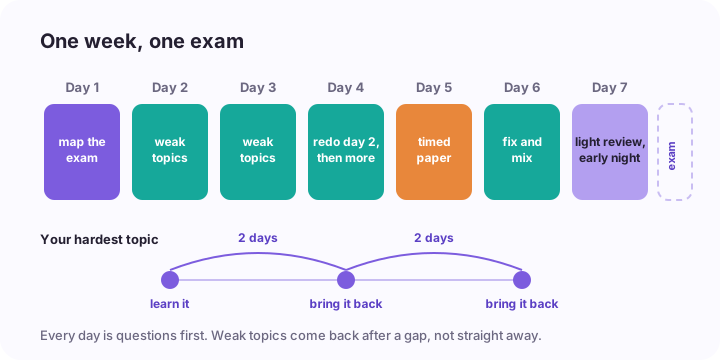
It's enough, if you use it well. With one week, spend the first day finding out where the marks are and what you don't know, spend the middle of the week testing yourself on the heaviest weak topics and bringing each one back two or three days later, sit one full practice exam under time pressure, and keep the last day light so you sleep properly. The plan below lays that out day by day. Most of your time goes on answering questions, not reading.
I build The Study Mill, so I'm biased about tools, but none of this needs one.
Why a week is different from a night
With one night you can only triage. I've written a rescue plan for the night before and it's mostly about deciding what to give up.
A week gives you something a night can't: time for spacing. Memory research has shown for a long time that the same amount of study spread over several sessions sticks far better than one long session. A big review of learning techniques by Dunlosky and colleagues in 2013 rated two strategies as the most useful across ages and subjects: spreading practice out, and testing yourself. Rereading and highlighting, the two things most of us do by default, came out near the bottom.
So the whole plan rests on two habits. Every session is questions first. Every important topic comes back on a later day.
Day 1: Map the exam and test yourself cold
Don't open the week 1 slides yet.
- Format. Multiple choice, short answer, case studies, essays? A law exam built on problem questions needs different practice from a pharmacology exam full of multiple choice.
- Weighting. If the unit outline says which topics or learning objectives carry the most marks, write that down.
- Past papers and practice questions. Gather everything your unit gives you.
- What the lecturer flagged. Review lectures, revision slides, anything said twice.
Then do a short diagnostic. Take a past paper or a set of practice questions and answer as many as you can in an hour, with no notes. It will feel bad, but the point is the list it gives you: the topics you can't answer yet.
End the day with a ranked list. Put topics that are worth a lot and that you're shaky on at the top. Topics worth little that you already know go at the bottom, and some of them may never get a session.
Days 2 and 3: The heavy, weak topics
Work down your list, two to four topics a day depending on their size. For each one:
- Try the questions first, from memory, even if your answer is poor.
- Check, then open the slides only for what you got wrong.
- Close the slides and try again. If you still can't do it, write it on a running "mistakes" page.
For a nursing student, that might be fluid and electrolytes on day 2 and medication safety on day 3. For a psychology student, research methods before the niche theory from week 9.
If you've got no questions for a topic, make them: turn each slide heading into a question and answer it before you read the slide. I go into why this works so much better than reading in active recall vs rereading.
Day 4: Bring day 2 back, then keep going
Start the day by redoing the questions you missed on day 2, without looking anything up first. This is the spacing doing its job. A two-day gap is long enough that you have to work to remember, and that effort is what makes it stick.
Then carry on down your list with the next topics.
Day 5: One full paper, under exam conditions
Sit a complete past paper (or the longest practice set you have) with a timer, no notes, phone in another room. Mark it honestly afterwards.
It tests the topics from days 2 to 4 after a gap, shows you how your timing holds up (where a lot of students lose marks they actually knew), and gives you a fresh mistakes list for day 6.
If you've only got one past paper, save it for today. Questions you've already seen are much easier the second time, and you want this one to be a fair test.
Day 6: Fix the mistakes and mix it up
Take everything you got wrong on day 5, plus your mistakes page from earlier in the week, and work through it. Questions first, slides only for the gaps.
Then do a mixed set: questions from all your top topics shuffled together, rather than one topic at a time. In the exam, questions won't arrive sorted by topic, so practising that way makes you work out which idea a question is testing, not just recall it.
Finish by writing a one-page cue sheet of the things you keep getting wrong, written as prompts ("Hyperkalaemia: ECG changes? first-line treatment?") rather than copied paragraphs.
Day 7: Light review and an early night
The day before the exam isn't for new topics. Run through your cue sheet, do a short mixed set, and check the exam time, room and what you're allowed to bring.
Then stop at a sensible hour. Sleep is when your brain consolidates what you learned, and research on sleep loss is consistent: going without it hurts memory and attention, which are the two things you need tomorrow. An all-nighter on day 7 throws away much of the work from days 1 to 6.
The plan at a glance
| Day | Focus | What you actually do |
|---|---|---|
| 1 | Map | Format, weighting, past papers, a cold diagnostic, ranked topic list |
| 2 | Weak topics | Questions first, slides for gaps, mistakes page |
| 3 | Weak topics | Same again, next topics on the list |
| 4 | Space and continue | Redo day 2 mistakes, then new topics |
| 5 | Timed paper | Full paper under exam conditions, marked honestly |
| 6 | Fix and mix | Day 5 mistakes, mixed questions, one-page cue sheet |
| 7 | Light review | Cue sheet, a short mixed set, logistics, early night |
If you have other exams in the same fortnight, this plan won't fit on its own. Use my finals week study schedule to share the days between subjects, and slot these steps into each subject's share.
Where The Study Mill fits
The hardest part of this plan for most students is having enough good questions. If your slides or notes are files, The Study Mill (which I build) turns each week you upload into short lessons, flashcards and a quiz drawn from that material, with written answers marked by AI. Questions you miss come back in daily review, which handles the "bring it back two days later" part for you, and "Swap for new ones" gives you a fresh set when you've seen the old one too often. Set an exam date and it plans revision across the days you have. The free plan covers 2 classes.
To be fair to past papers: if your unit has them, they beat anything an app can write, because they come from the person who writes your exam. Use them on days 1 and 5 whatever else you use.
If you want somewhere to start tonight, upload the lecture you're most worried about and try its quiz before you read a single slide. That's day 1 done.
This is general study advice, not official guidance. If illness or a clash affects your exam, check your university's special consideration policy.