
Picture a nursing student doing acid-base practice questions. Twenty on respiratory acidosis, all in a row, and by question six she's flying. Then the exam hands her one blood gas with no heading on it, and she freezes. Is it respiratory or metabolic? Is it compensated? Nobody told her which chapter it came from.
That's the problem interleaving fixes. Interleaving means mixing different topics or problem types within one study session, instead of finishing all of one before starting the next. It feels slower and messier while you do it, and you'll get more wrong in practice. But in study after study, mixed practice leads to better results on the later test, especially when the topics are easy to confuse with each other.
Blocked vs interleaved practice
Most of us study in blocks without thinking about it. Textbooks are written that way, lectures are delivered that way, and practice questions usually come grouped under a heading. Week 3 is cardiac drugs, so you do the cardiac drug questions.
Interleaving uses the same questions, just shuffled.
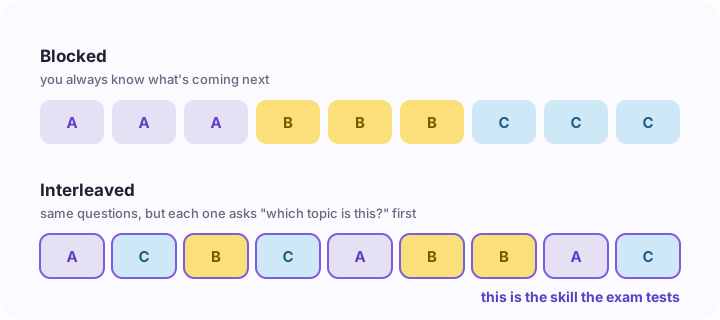
The difference looks tiny. It isn't. In a blocked set, the heading does half the work for you. You already know it's a beta blocker question, so you only have to remember beta blockers. In a mixed set, each question first asks you something you never practised: what kind of problem is this, and which method do I reach for?
That second step is exactly what an exam asks of you. Exam papers don't group questions by lecture week, and clinical placements definitely don't.
What the research actually found
Interleaving is one of the better-studied ideas in learning science, and two findings come up again and again.
It helps you tell similar things apart. In a well-known experiment by Nate Kornell and Robert Bjork, people learned the painting styles of a dozen artists, either by seeing each artist's paintings in a row or with all the artists mixed together. The mixed group was better at recognising new paintings by those artists afterwards. Doug Rohrer and Kelli Taylor found a similar pattern with maths problems: students who practised mixed problem types did worse during practice but better on the test that followed. Later classroom studies led by Rohrer with school maths students pointed the same way.
It feels like it's working less. This is the strange part. In the painting study, most people believed blocking had helped them more, even after their own test results showed the opposite. Blocked practice feels smooth because you keep getting things right. Mixed practice feels clumsy because you keep getting things wrong. Your sense of how well you're learning is a poor guide here.
Researchers call this a "desirable difficulty": something that makes practice harder in a way that makes the memory stronger. It's the same reason active recall beats rereading. The effort is the point of the exercise, not a sign you're doing it badly.
Where interleaving helps most (and where it doesn't)
Interleaving isn't magic shuffling. It earns its keep when the topics look alike on the surface but need different answers. Some examples from the subjects our users study:
- Nursing and pharmacology: ACE inhibitors vs ARBs vs beta blockers. Similar uses, different side effects and cautions.
- Medicine: the different types of shock, or telling causes of chest pain apart.
- Law: working out whether a fact pattern is negligence, nuisance or trespass before you apply any rules.
- Psychology statistics: choosing between a t-test, ANOVA and chi-square. Most students can run each test. Far fewer can pick the right one cold.
Mixing completely unrelated subjects, like an hour that jumps between anatomy and accounting, doesn't get you the same benefit, because there's nothing to confuse. It's the near neighbours that need separating.
It also isn't the right tool on day one. When a topic is brand new, a short block of focused practice so you understand the basics is sensible. Interleave once you can do each type on its own and the job becomes choosing between them.
How to interleave without making a mess of it
You don't need a new system. A few small changes do most of the work.
Mix your practice questions across weeks. Instead of doing this week's quiz alone, do a set that also pulls from two or three earlier weeks. If your questions are on paper, number them, shuffle the cards and hide the headings.
Write the question type before you answer. Before solving, jot down one line: "metabolic acidosis, partially compensated" or "this is a nuisance problem". That forces the identification step, which is the bit blocked practice skips.
Pair interleaving with spacing. These two fit together naturally. When you come back to older weeks on a spaced repetition schedule, mix them in with the new material instead of reviewing each week on its own.
Expect your scores to dip. If your practice mark drops when you start mixing, that's normal, and the research says it's usually a good sign. Judge it by how you go on mixed questions a week later, not how you go today.
Use it hardest before multiple-choice exams. Good distractors are often the neighbouring concept. Mixed practice is how you learn to spot them. More on studying for multiple choice.
Doing this in The Study Mill
I build The Study Mill, so take this with that in mind. The app is organised by class and week, which is great for learning each lecture and, honestly, a bit blocked by default. Each week gets its own lessons, flashcards and quiz.
The way to interleave with it is to stop finishing one week and moving on. Once you've done the first pass on a few weeks, do a quiz from one week, then flashcards from another, then the quiz from a third, in one sitting. The daily review helps too, because it brings back questions you missed earlier, so older material keeps turning up between newer work. And if a quiz starts to feel familiar, "Swap for new ones" gives you a fresh set so you're not just recognising the questions.
Anki users can get a similar effect by studying a parent deck that contains several subdecks, so reviews from different topics can come up mixed together.
Try it on your next study session
Pick two or three lectures that cover things you tend to mix up. Do the practice questions shuffled together, and name each question's type before you answer. It will feel worse than your usual session. Check yourself a week later and see which way stuck.
If you want questions to mix in the first place, upload one lecture to The Study Mill and it'll write the quiz and flashcards from your own slides. The free plan covers two classes.