You read the card on the door. Sixty-eight-year-old, short of breath, take a set of observations and hand over. The bell goes, you walk in, and the examiner is sitting there with a clipboard, not saying a word. You've taken a blood pressure a hundred times on placement. Right now you can't remember whether you introduced yourself.
An OSCE (objective structured clinical examination) doesn't test what you know so much as what you do and say while someone watches and a clock runs. So the way to prepare is to practise stations out loud and with your hands, against the marking criteria, until the routine runs on its own. Build one fixed frame for every station (the same opening and the same close), rehearse it with a timer and a partner, and say your thinking out loud, because an examiner can only mark what they can see and hear.
I build The Study Mill, so I'm biased about study tools. Most of this post needs no app at all. You can't learn to take a pulse from a screen.
What the examiner is actually marking
Most OSCE stations are marked against a checklist of observable steps, often with an overall rating of how competent and safe you seemed on top. Check what your unit uses. If your course gives you the marking criteria or a skills assessment sheet, that is the most valuable document you have. Print it.
Two things follow from how stations are marked.
First, unspoken steps often don't count. If you check the patient's identification band in your head but don't say it or show it, the examiner may have no way to tick it. Students who are quietly competent lose marks this way all the time.
Second, some steps matter more than others. Many programs treat certain errors as critical, such as skipping patient identification before a medication, breaking aseptic technique or doing something unsafe. In many marking schemes, one of these can fail the station however well the rest went. Find out which steps your course treats as critical and make them automatic before anything else.
Build one frame for every station
The stations change. The frame shouldn't. Having the same opening and close for every station means that even when the middle goes wrong, you start and finish cleanly, and those are often where the easy marks sit.
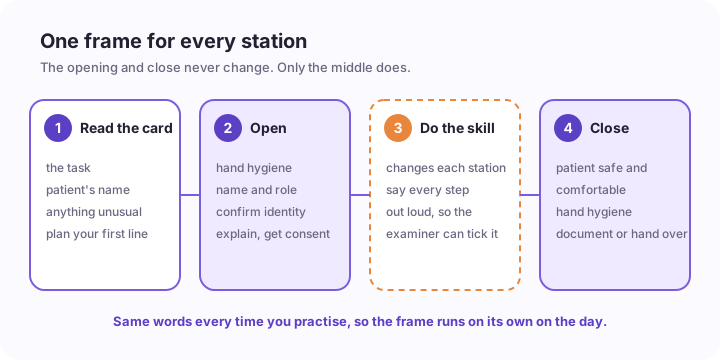
A frame that works for most nursing and medical stations:
- Read the card properly. Use the reading time to note the task, the patient's name and anything unusual. Plan your opening line.
- Open. Hand hygiene, introduce yourself with name and role, confirm the patient's identity, explain what you're going to do and get consent. Check for pain or allergies where it's relevant.
- Do the skill. Narrate as you go: "I'm checking the cuff size against the arm", "I'm looking at the site for redness or swelling".
- Close. Make the patient comfortable and safe, clean up, perform hand hygiene, then document or hand over. If the station asks for a handover, use the structure your course teaches, often ISBAR in Australia.
Say the opening the same way, word for word, every time you practise. On the day it will come out by itself, and getting those first thirty seconds right is often what settles the nerves.
Practise with your hands, out loud, on a timer
Reading a skills checklist feels like preparation. It isn't the same as doing the skill, any more than rereading notes is the same as answering questions. The research on active recall applies here too: you get better at what you practise retrieving, and in an OSCE, what you retrieve is a sequence of actions and words.
A practice routine that works:
- Write each station as a numbered list from the marking criteria, then close it and try to say every step from memory. Whatever you miss is what you practise next.
- Run the full station with a timer. Most students are surprised by how short the time feels. If you finish early in practice, slow down and narrate more. If you run over, find the step you're dithering on.
- Use a partner as the examiner. Give them the marking sheet and ask them to tick only what they see or hear. Then swap. Watching someone else do a station is a fast way to spot steps you skip yourself.
- Practise in the lab if you can book it. Equipment you've handled is far less likely to throw you on the day. If your skills lab has open sessions before the OSCE, use them.
- Record yourself on your phone. Watching back is uncomfortable and very useful. You'll spot the step you thought you said but didn't.
Mix the stations up once you know them, rather than practising the same one five times in a row. On the day you won't know which station comes next, and switching between skills in practice prepares you for that.
Learn the why behind each step
Examiners often ask a question at the end. "Why did you do that?" "What would you do if the reading was 80 over 50?" "What would you report?" Rote steps won't answer those.
For each skill, know the reason behind every step and the normal ranges you'd be checking against. That's ordinary content study, and it's where flashcards and practice questions help. If you know the condition as a chain from cause to signs to nursing action, as I described in how to study for nursing exams, the examiner's follow-up question is just another link in that chain.
This is also the part of OSCE prep The Study Mill can help with. Upload the lecture slides for the skills and conditions in your OSCE and it builds lessons, flashcards and a quiz from that material, including written answers it marks. Walk & Learn has two hosts teach the week as audio and ask you questions you answer out loud, which is handy practice at explaining your reasoning in spoken words. The free plan covers 2 classes. It won't teach your hands anything. Practice in the lab with a partner will.
If something goes wrong mid-station
It probably will, in at least one station. You'll drop something, forget a step or blank on a number.
- Say it and fix it. "I've just realised I haven't checked the identification band, I'll do that now." Correcting yourself out loud is usually far better than carrying on and hoping it wasn't noticed, and for a safety step it may be the difference between passing and failing.
- Fall back to the frame. If you lose your place, return to the next step you're sure of. The frame is there for exactly this.
- Leave each station at the door. Every station is marked separately. A bad one doesn't follow you into the next room unless you let it.
If nerves are the main problem, the breathing and reframing tricks in how to stay calm in an exam work just as well between OSCE stations as in an exam hall.
The week before
- Get the station list or the skills that could come up, and make sure you've run each one out loud at least a few times.
- Do one full mock with a partner, in uniform, with stations back to back and a timer. It makes the real thing feel familiar.
- Check the practical details: uniform rules, what to bring (watch with a second hand, pen, ID), where to be and when.
- Sleep. Hands shake more when you're tired, and everything takes longer.
If your OSCE covers material from lectures you haven't revised properly, upload one of those lectures to The Study Mill tonight and test yourself on the reasons behind the steps. Then put the phone down and go practise the skill itself.
This is general study advice, not clinical guidance. Follow your program's marking criteria, your clinical educators and your local policies for how each skill should be performed.