
Cholecystectomy. Gastroenteritis. Hepatosplenomegaly. A first medical terminology unit hands you a glossary that runs for pages, and the obvious plan is one flashcard per word. That plan is slow, and it falls apart the first time a placement chart uses a word that wasn't on your list.
The faster way is to stop learning words and start learning the pieces they're built from. Most medical terms are a few Greek or Latin parts stuck together: a prefix, a root, a combining vowel and a suffix. Learn a couple of hundred common parts, read every new term from the suffix back to the front, and test yourself by both breaking words apart and building them. That way each part you learn decodes dozens of words, including ones you've never seen.
How a medical word is built
Nearly every textbook teaches the same four building blocks:
- Root: the core meaning, usually a body part. Gastr means stomach, hepat means liver, cardi means heart.
- Suffix: the ending, which tells you what's happening. -itis is inflammation, -ectomy is surgical removal, -megaly is enlargement.
- Prefix: an optional start that adds position, number or amount. Hyper- is above or excessive, brady- is slow, peri- is around.
- Combining vowel: usually an "o", added so the word can be said out loud. A root plus its vowel (gastr/o) is called a combining form.
The vowel follows a simple rule. Keep it between two roots and before a suffix that starts with a consonant. Drop it before a suffix that starts with a vowel. That's why it's gastr/o/scopy but gastr/itis.
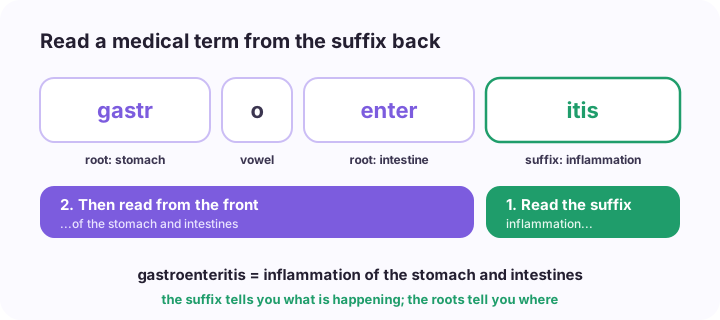
Read it backwards
This is the trick that makes long words manageable. Start with the suffix, then go back to the beginning and read left to right.
Gastroenteritis: -itis (inflammation), then gastr/o (stomach) and enter (intestine). Inflammation of the stomach and intestines. Cholecystectomy: -ectomy (removal), then chol/e (bile) and cyst (bladder or sac). Removal of the gallbladder. Hepatosplenomegaly: -megaly (enlargement) of the hepat/o (liver) and splen (spleen).
The suffix is the verb of the word. Once you know whether something is being inflamed, cut out, looked into or enlarged, the rest is just where.
Step 1: Build a parts list, not a word list
Go through your unit's glossary or first lecture and pull out every part you can see. Put each one on its own card with its meaning and two example words from your course. Most courses lean on a fairly small set of parts that repeat across body systems, so a couple of hundred well-learned parts goes a long way.
Group them so they're easier to hold:
| Group | Examples |
|---|---|
| Surgical suffixes | -ectomy (remove), -otomy (cut into), -ostomy (make an opening), -plasty (repair) |
| Diagnostic suffixes | -scopy (look inside), -graphy (record an image), -centesis (puncture to drain) |
| Condition suffixes | -itis (inflammation), -osis (abnormal condition), -algia (pain), -megaly (enlargement) |
| Number and amount prefixes | hypo- (below), hyper- (above), poly- (many), olig- (few) |
| Position prefixes | sub- (under), peri- (around), endo- (within), epi- (on top of) |
Your course will have its own emphasis, so build this table from your own slides rather than learning mine.
Step 2: Learn the roots by body system
Roots stick better when they're attached to something. Learn them in the same body systems your course uses: the cardiovascular roots together, then the digestive ones, then respiratory. If you're doing anatomy at the same time, it's the same decoding habit I describe in how to study anatomy, and the two units reinforce each other.
Some body parts have two roots, one from Greek and one from Latin. Kidney is both nephr/o (nephrology) and ren/o (renal). Mouth is both stomat/o and or/o. Learn them as pairs on one card so you don't treat them as separate facts.
Step 3: Put the lookalikes side by side
A handful of parts look or sound almost the same and cause most of the lost marks. Give each pair its own card and make yourself say what's different:
- ileum and ilium: part of the small intestine versus part of the hip bone
- -otomy and -ostomy: cutting into something versus making a permanent opening
- hypo- and hyper-: below normal versus above normal, which flips the whole meaning of hypoglycaemia and hyperglycaemia
- arteri/o and arthr/o: artery versus joint
Multiple choice exams love these, because a half-prepared student will pick the one that looks right at a glance. If you want more on how those questions are built, see how to study for multiple choice exams.
Step 4: Test yourself in both directions
Recognising a word when you read it is the easy half. Exams also give you a definition and ask for the term, and in practice you'll need to write it, spelled correctly. So quiz both ways:
- Break it: see "pericarditis", say the parts and the meaning.
- Build it: see "inflammation of the sac around the heart", write the word.
Testing yourself like this beats rereading by a wide margin in learning research, and building words is the harder, more useful half. I go into why in active recall vs rereading.
Step 5: Say it out loud
Terminology is spoken on wards as much as it's written. Say each word as you study it, and listen to it pronounced if your course provides recordings. It also helps your spelling, because you'll notice the parts as you sound them out. Watch the Australian spellings your course uses, too: haemorrhage, oedema and anaemia rather than the American versions.
Step 6: Keep abbreviations separate, and careful
Abbreviations aren't word parts, and they're where clinical errors happen. In Australia, the Australian Commission on Safety and Quality in Health Care publishes recommendations on which medicines abbreviations are safe to use and which to avoid, updated in 2024 as Recommendations for safe use of medicines terminology. Learn your course's approved list as its own small deck, and don't invent shortcuts.
A rhythm that works
| When | What | Time |
|---|---|---|
| After each lecture | Pull out new parts, add to your parts deck | 15 min |
| Daily | Review due parts, break and build a few words | 10 min |
| Weekly | Mixed quiz across all body systems so far | 20 min |
| Before the exam | Unfamiliar words: decode terms you've never seen | 20 min a day |
That last row is the real test. If you can decode a word that wasn't in your glossary, you've learned the system, not the list.
Where The Study Mill fits
I build The Study Mill, so weigh this accordingly. If your terminology unit comes as lecture slides, PDFs or a glossary document, you can upload each week and it turns that week into short lessons, flashcards and a quiz written from your material, so the parts and terms match what your lecturer set, not a generic list. The quiz mixes multiple choice with written answers marked by AI, which suits the "build the word" direction. Questions you miss come back in daily review, and Walk & Learn turns the week into audio where Milli and Luke ask you questions you answer out loud, which is good practice for pronunciation.
It won't replace your course's approved abbreviation list or a medical dictionary. And if you'd rather make every card by hand, Anki does word-part decks very well. The free plan covers 2 classes, enough to try it on terminology and one other unit.
Take your next terminology lecture, split every term on one slide into its parts before you make a single flashcard, and see how many parts you already knew. The glossary usually turns out much shorter than it looked.
This is general study advice, not clinical guidance. Follow your course materials and your health service's approved terminology and abbreviation lists.