
Week four of a microbiology unit is usually where it tips over. Staphylococcus aureus, Streptococcus pyogenes, Escherichia coli, Pseudomonas aeruginosa, Clostridioides difficile, Neisseria meningitidis, all in one lecture, each with its own diseases, tests and antibiotics. Most students make one flashcard per organism, try to hold forty Latin names in their head, and feel the whole lot slide away by the exam.
The better way is to learn microbiology as a set of patterns. Sort every organism by a few big features first (Gram stain, shape, how it grows), learn each one as a short profile in the same order every time, pair it with the drugs that work on it, then test yourself starting from the patient rather than the bug. Exams rarely ask you to recite facts about one organism. They describe a patient or a lab result and ask what it is, why it happened and what treats it. Patterns answer that. Isolated facts don't.
1. Sort before you memorise
Before learning a single disease, put each organism into a box. For bacteria, the first two questions are almost always the Gram stain and the shape.
The Gram stain splits bacteria by their cell wall. Gram-positive bacteria have a thick layer of peptidoglycan that holds onto the purple crystal violet dye. Gram-negative bacteria have a thin layer of peptidoglycan plus an outer membrane, so the dye washes out and they pick up the pink counterstain. Then comes the shape: round cocci or rod-shaped bacilli, and whether the cocci sit in clusters, chains or pairs.
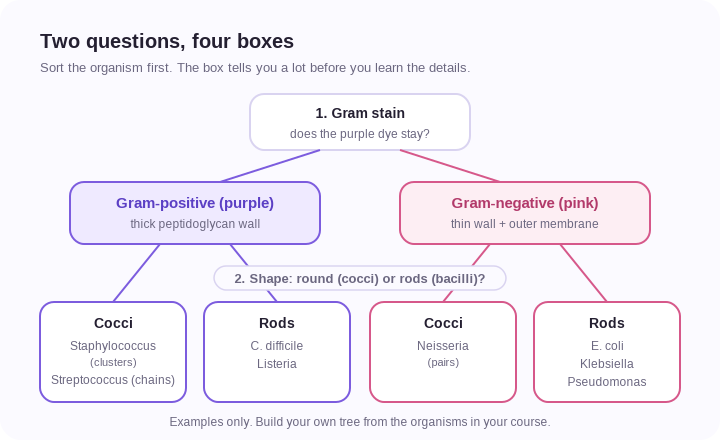
This matters because the box carries information. That outer membrane is part of why some antibiotics that work well on Gram-positive bacteria, like vancomycin, don't help against Gram-negative ones. It also contains lipopolysaccharide, which is why Gram-negative infections are closely tied to septic shock in your lectures. Learn what the box means once, and every organism you drop into it inherits those facts.
Your course decides which organisms matter and which other features it sorts by (oxygen needs, spore forming, acid-fast staining for mycobacteria). Build your sorting tree from your own slides, not mine.
2. Learn every organism as one profile, in the same order
Once an organism has a box, give it a profile card with the same headings every time. A fixed order means you're never deciding what to learn next, and in the exam you can walk through the headings to find what you know.
| Heading | Staphylococcus aureus (example) |
|---|---|
| Box | Gram-positive cocci in clusters |
| Where it lives | Skin and nose of many healthy people |
| How it causes harm | Toxins and enzymes, invades broken skin |
| Classic diseases | Skin and wound infections, abscesses |
| How it's identified | Gram stain and culture, plus tests your lab teaches |
| What treats it | Depends on resistance, which is why MRSA matters |
| The exam hook | The difference between MRSA and sensitive strains |
The last row is the one most students skip. Every organism in your course is there for a reason, and the lecturer usually tells you what it is: the one that causes hospital outbreaks, the one linked to antibiotic use, the one that's dangerous in pregnancy. Write that reason down. It's often the question.
3. Pair bugs with drugs, through the mechanism
Microbiology and pharmacology overlap more than most course outlines admit. When you learn an antibiotic class, link it to what it attacks. Penicillins and other beta-lactams interfere with building the cell wall. Others target protein synthesis or DNA. Once you know the mechanism, a lot of "which drug for which bug" stops being a list and becomes reasoning: a drug that can't get through the outer membrane won't do much to a Gram-negative organism.
If antibiotic names are the bit you're stuck on, the endings method in how to memorise drug names works for -cillins and -floxacins too. Learn the class once, then pin organisms to it.
Keep resistance in the same card. MRSA, vancomycin-resistant enterococci and multi-resistant Gram-negatives turn up in nursing and medicine exams because they turn up on wards. A single line per organism ("watch for this resistance, and here's why it matters") is enough to start.
4. Use the chain of infection as your skeleton
For nursing students in particular, infection control questions lean on the chain of infection: the infectious agent, its reservoir, the portal of exit, the mode of transmission, the portal of entry and a susceptible host. Break any link and the infection doesn't spread.
Map each organism onto that chain. C. difficile forms spores that survive on surfaces, which is why your course will stress soap and water and environmental cleaning, not just alcohol hand rub. A respiratory virus that travels in droplets points you towards different precautions from a bug spread by contact. This turns a list of organisms into the kind of clinical reasoning that the questions in how to study for nursing exams are built around.
This is general study advice, not clinical or infection control guidance. Follow your course materials and your health service's own policies for the content itself.
5. Test yourself from the patient backwards
Microbiology exams usually start with a scenario: an older patient with diarrhoea after a course of antibiotics, a teenager with a fever and a rash that doesn't fade under pressure, a Gram stain showing purple cocci in clusters. So practise in that direction.
Three ways to do it:
- Start from the slide or the lab result. "Gram-negative rods in a urine sample from a patient with a catheter. Likely organisms?"
- Start from the patient. Read a short scenario and work out the box, the organism and what you'd expect next.
- Swap one detail. What changes if the organism is resistant? If the patient is immunocompromised?
Write your flashcards the same way. "What diseases does S. aureus cause?" invites a list. "A post-op wound has pus and purple cocci in clusters. What's the organism, and what's the first thing you'd want to know about it?" makes you use the pattern. Retrieval like this, spread over the semester, is the most reliable way to keep forty organisms from blurring together. Active recall vs rereading covers why.
A weekly rhythm
| When | What | Time |
|---|---|---|
| Same day as the lecture | Add the new organisms to your sorting tree | 10 min |
| Same day | Write a profile card for each, same headings | 20 min |
| Next day | Fill in one profile from a blank page, then check | 15 min |
| Later in the week | Three patient-backwards questions | 15 min |
| Weekly | Compare two organisms from the same box | 15 min |
The last row catches the organisms that get confused. Staphylococcus and Streptococcus are both Gram-positive cocci, so the exam will test whether you know how they differ: clusters or chains, the test your lab uses to tell them apart, and the diseases each one is known for.
Where The Study Mill fits
I build The Study Mill, so I'm biased. If your micro unit comes as lecture slides, PDFs or recordings, you can upload each week and it writes short lessons with analogies, flashcards and a quiz from your lecturer's own material, so the organisms you're quizzed on are the ones your course covers. The quiz mixes multiple choice with written answers marked by AI, which suits scenario questions. Questions you miss come back in daily review, and Walk & Learn has Milli and Luke talk the week through as audio and ask you questions you answer out loud.
It won't build your sorting tree for you, and drawing it yourself is a big part of the learning. The free plan covers 2 classes, so you can try it on micro and one other unit.
Take this week's lecture. Sort every organism into a box, write one profile card, and tomorrow try to fill it in from memory. Whatever heading stays blank is where to start.