Your unit has posted three past papers. You also have a tutorial workbook, the questions at the end of each textbook chapter, and an app that will write a quiz on any lecture you give it. The exam is three weeks away. Do you start with the past papers because they're "real", or save them because there are only three?
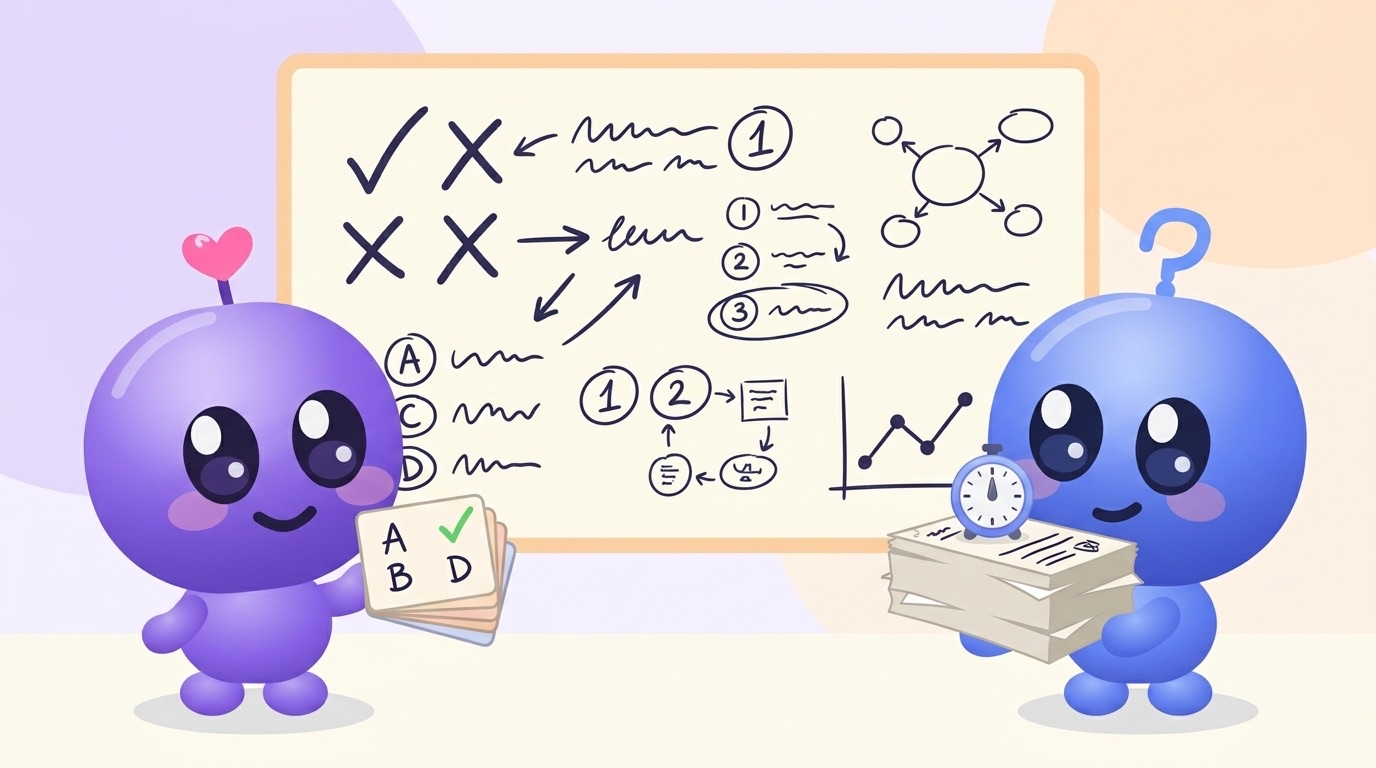
Use practice questions to learn, and past papers to check. Practice questions are for building knowledge one topic at a time: you can do as many as you want, on exactly the topic you're weak on, and look things up between attempts. Past papers are for finding out whether that knowledge holds up in the exam's real format, mixed together, against the clock. Do one past paper early as a cold diagnostic, spend most of your time on practice questions, and save the rest of the papers for timed runs in the last week or two.
What each one is actually good for
Both are a form of testing yourself, which is one of the best-supported study methods there is. A large 2013 review of common study techniques rated practice testing as one of only two with high usefulness, alongside spacing your study out. Rereading and highlighting came out near the bottom. So you're already doing the right kind of thing whichever you pick. The question is which tool fits which job.
| Practice questions | Past papers | |
|---|---|---|
| Supply | Unlimited, or close to it | Usually a handful, sometimes none |
| Focus | One topic at a time, your choice | Every topic, mixed, in the exam's proportions |
| Format | Whatever the source uses | The real format, mark scheme and timing |
| Best for | Learning and fixing weak topics | Diagnosing gaps and rehearsing the day |
| Cost of using one up | None | You can only sit it fresh once |
That last row matters more than people think. A past paper you've already seen is a much easier paper. Once you know question 4 is about the renin-angiotensin system, your second attempt measures memory of the paper, not of the content.
Why past papers are worth protecting
Past papers come from the person who writes your exam, or at least from the same unit. They tell you things no other source can:
- How questions are phrased, and how much detail a "describe" gets compared with an "explain".
- Which topics come up nearly every year, and which barely appear.
- How long a question really takes you, and where you run out of time.
There's also a matching effect in memory research, sometimes called transfer-appropriate processing: you tend to do best on a test when the thinking it asks for matches the thinking you practised. A law student who has only reviewed case summaries can recite the facts of every case and still freeze on a problem question, because the exam asks them to apply cases to new facts, which is a different skill. A past paper is the clearest picture you'll get of what thinking the exam wants.
The research isn't perfectly tidy here. Some studies find that mixing question formats in practice works as well as or better than matching the exam exactly, and that effortful recall matters more than format. I read that as: match the kind of thinking, not every detail of the layout.
Why practice questions do most of the work
If past papers are so good, why not only use them? Because you'd run out on day two.
Learning a topic properly takes many attempts at retrieving it, spread over days, with feedback each time. Ten questions on beta blockers. Then ten more three days later, worded differently so you can't coast on remembering the answer. You can't get that from three past papers that cover the whole semester.
Practice questions also let you work where you're weak. If the diagnostic paper showed you can't tell a type I hypersensitivity reaction from a type IV, you need a dozen questions on hypersensitivity, not another full paper where it appears once.
The catch is quality. Questions from a textbook or a random website may not match your unit's emphasis, and AI-written multiple choice often has tells that let you guess without knowing. I wrote about the one we found in our own app in the answer was B 72% of the time. Whatever source you use, make sure the questions force you to retrieve the answer rather than spot it.
A simple way to use both
Here's the order I'd suggest for a unit with a few past papers and a few weeks:
- Week one, day one: sit one past paper cold. Timed if you can bear it, notes closed. Mark it honestly and rank topics by how many marks they're worth and how badly you did. This is the only time a bad score is good news, because it tells you where to spend the next fortnight.
- The middle weeks: practice questions on the ranked topics. Answer first, check, look up only what you got wrong, then try again. Bring each weak topic back a few days later with fresh questions.
- One to two weeks out: a second past paper, timed. Full conditions, phone in another room. Compare with the first. What's still weak goes back to step 2.
- The last few days: the final past paper, if you have one. A dress rehearsal, then fix whatever it shows and stop.
If you want this laid out day by day, my two-week exam study plan uses exactly this structure, with rest days built in.
What if there are no past papers?
Plenty of units don't release them, or only release one with no answers. A few things help:
- Ask. Lecturers often share a sample question or the format even when they won't share old papers. Learning objectives are a good stand-in for what they'll test.
- Build your own mock. Pull questions from across every topic in roughly the weighting the unit outline gives, mix them up, and sit them timed. It won't have the lecturer's phrasing, but it trains the mixed, timed part.
- Copy the format. If the exam is short answer, practise writing short answers, not ticking boxes. If it's multiple choice, the habits in how to study for multiple choice exams apply.
Mistakes that waste a past paper
- Doing it open book. Peeking at your notes turns a diagnostic into a reading exercise. Answer what you can, leave blanks, then look.
- Only reading the answers. Reading a worked solution feels like understanding. Cover it, try the question, then compare.
- Doing every paper in the first week. You'll feel productive, then have nothing fresh left to check yourself with before the exam.
- Not marking it. A paper you sat but didn't mark tells you almost nothing. The marking is where the list of gaps comes from.
Where The Study Mill fits
I build The Study Mill, so I'm biased. It sits on the practice question side of this. You upload your own slides, notes or lecture recordings, and each week becomes a quiz that mixes multiple choice with written answers marked by AI, built only from what you uploaded. Daily review brings back the questions you missed, and "Swap for new ones" gives you a fresh set so you're not memorising the same ten. The free plan covers two classes; Pro adds exam mode and cram sheets.
To be fair: it can't replace your unit's past papers. They come from the person who writes your exam, and nothing an app writes beats that. Use the app (or a workbook, or a study partner) for the volume, and keep the real papers for the checks.
If you want to try it, upload one lecture from your weakest topic and see whether the questions find the same gaps your past paper did.