
The question reads: "A researcher finds that students who drink more coffee get higher exam marks. She concludes that coffee improves exam performance. Evaluate this conclusion." You know the words correlation and causation. You've seen them on a slide. But there are six marks on offer and you're not sure what to write after "correlation does not equal causation".
That's the pattern with research methods in psychology. The exam rarely asks you to define a term. It gives you a short study and asks you to identify the variables, spot what's wrong with the design, and say what the results can and can't tell you. The concepts that come up most are the independent and dependent variables, confounds, operational definitions, reliability versus validity, sampling, and the line between correlation and causation. Learn each one well enough to find it in a scenario you've never seen, and most of the unit falls into place.
Start with the anatomy of a study
Almost every research methods question can be answered by pulling a study apart into the same few pieces. Do that first, every time, before you think about what's wrong with it.
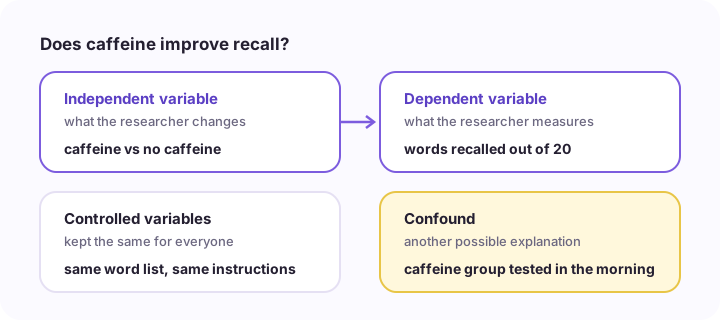
Independent variable (IV). What the researcher deliberately changes or compares. Caffeine versus no caffeine. Therapy A versus therapy B.
Dependent variable (DV). What they measure to see if the IV made a difference. Number of words recalled. Score on an anxiety scale.
Controlled variables. Things kept the same across groups so they can't explain the result: time of day, the word list, the instructions.
Confounds. Anything other than the IV that differs between the groups and could explain the result. If the caffeine group did the test in the morning and the control group after lunch, you can't tell whether caffeine or time of day made the difference.
A good habit is to write those four labels in the margin of every scenario and fill them in before you read the question. Most marks on design questions come from naming a confound precisely and saying how it could be fixed.
Operational definitions
"Memory" isn't something you can measure. "Number of words correctly recalled from a 20-word list after five minutes" is. An operational definition says exactly how a variable is measured or manipulated in this study.
Exams test this in two ways. They ask you to write one for a variable in the scenario, or they ask whether the operational definition really captures the concept. Counting how many times a child hits a doll is a measure of aggression, but a narrow one. That second kind of question is really about validity.
Reliability versus validity
This pair causes more lost marks than anything else in the unit, because students learn the definitions and then swap them under pressure.
Reliability is consistency. Would you get the same result if you measured again (test-retest), if a different observer scored it (inter-rater), or if you used a different set of items measuring the same thing (internal consistency)?
Validity is accuracy. Are you measuring what you claim to measure, and can you draw the conclusion you're drawing? Internal validity asks whether the IV really caused the change in the DV, which is where confounds come in. External validity asks whether the result generalises to other people, settings and times.
The line I'd memorise: a measure can be reliable without being valid, but it can't be valid without being reliable. A bathroom scale that always reads 3 kg heavy is perfectly consistent and consistently wrong.
Sampling and generalising
Who took part decides who the results apply to. Random sampling gives everyone in the population an equal chance of being chosen, which supports generalising. Convenience sampling (first-year psych students, because they're there) is quick and common, and it limits how far the findings stretch.
Don't confuse random sampling with random allocation. Random sampling is about who gets into the study. Random allocation is about which group each participant goes into once they're in. Allocation is what protects internal validity, because it spreads participant differences evenly across conditions. Exams love asking you to tell the two apart.
Related designs come up too. In a between-subjects design, different people do each condition. In a within-subjects (repeated measures) design, the same people do all of them, which controls for individual differences but brings order effects like practice and fatigue. Counterbalancing, where half the participants do the conditions in one order and half in the other, is the standard fix.
Correlation and causation, properly
Back to the coffee question. "Correlation does not equal causation" is the start of the answer, not the answer. The marks are for explaining why in this case.
There are two things to say. First, direction: maybe doing well makes students study longer, and studying longer means more coffee. Second, a third variable: perhaps more conscientious students both drink more coffee and study more, and it's conscientiousness doing the work. Name a plausible third variable from the scenario, then say what design would test the claim: randomly allocate students to caffeine or placebo, with the study blind so expectations don't leak in.
Once you can do that for coffee, you can do it for screen time and sleep, social media and mood, or any other correlational scenario the examiner writes.
Ethics, briefly
Most units include a short set of ethical principles: informed consent, the right to withdraw, confidentiality, minimising harm, and debriefing when deception was used. In Australia these sit under the National Statement on Ethical Conduct in Human Research. Questions usually give you a study and ask which principle was breached. Learn each principle with one concrete example of a breach and you'll recognise it quickly.
This is general study advice. Your unit outline and lecture content are the final word on the definitions and terms your exam uses, since textbooks label some of these slightly differently.
How to study it
Research methods rewards practice on scenarios far more than rereading definitions. A few things that work:
Make your own mini studies. Take any claim from your week ("music helps concentration") and design a study for it. Name the IV and DV, write an operational definition for each, list two controls and one likely confound. Ten minutes of this beats an hour of highlighting.
Test the pairs that get swapped. Reliability and validity. Random sampling and random allocation. Internal and external validity. Make a flashcard that asks you to tell each pair apart with an example, not just define them. If you're unsure why testing yourself beats reading your notes again, I wrote about active recall vs rereading.
Practise on scenarios you haven't seen. Many research methods exams are partly multiple choice, with options written to catch the exact swaps above. These multiple choice tactics help, and so does working through past papers alongside practice questions so you've met the examiner's style before the day.
Where The Study Mill fits
I build The Study Mill, so I'm biased. You upload your research methods slides, readings or lecture recordings, organised by class and week, and each week becomes short lessons with analogies, flashcards, notes, and a quiz that mixes multiple choice with written answers marked by AI. The written answers suit this unit well: you explain why a design has a confound in your own words, and it tells you what you missed. Everything comes only from what you uploaded, so it uses your lecturer's terms rather than a textbook from somewhere else.
To be fair about the limits, it won't replace working through your tutorial scenarios or a full past paper under time. The free plan covers two classes; Pro adds exam mode and cram sheets.
If you want to try it, upload one week of research methods and see whether you can name the IV, DV and confound in every scenario it gives you.