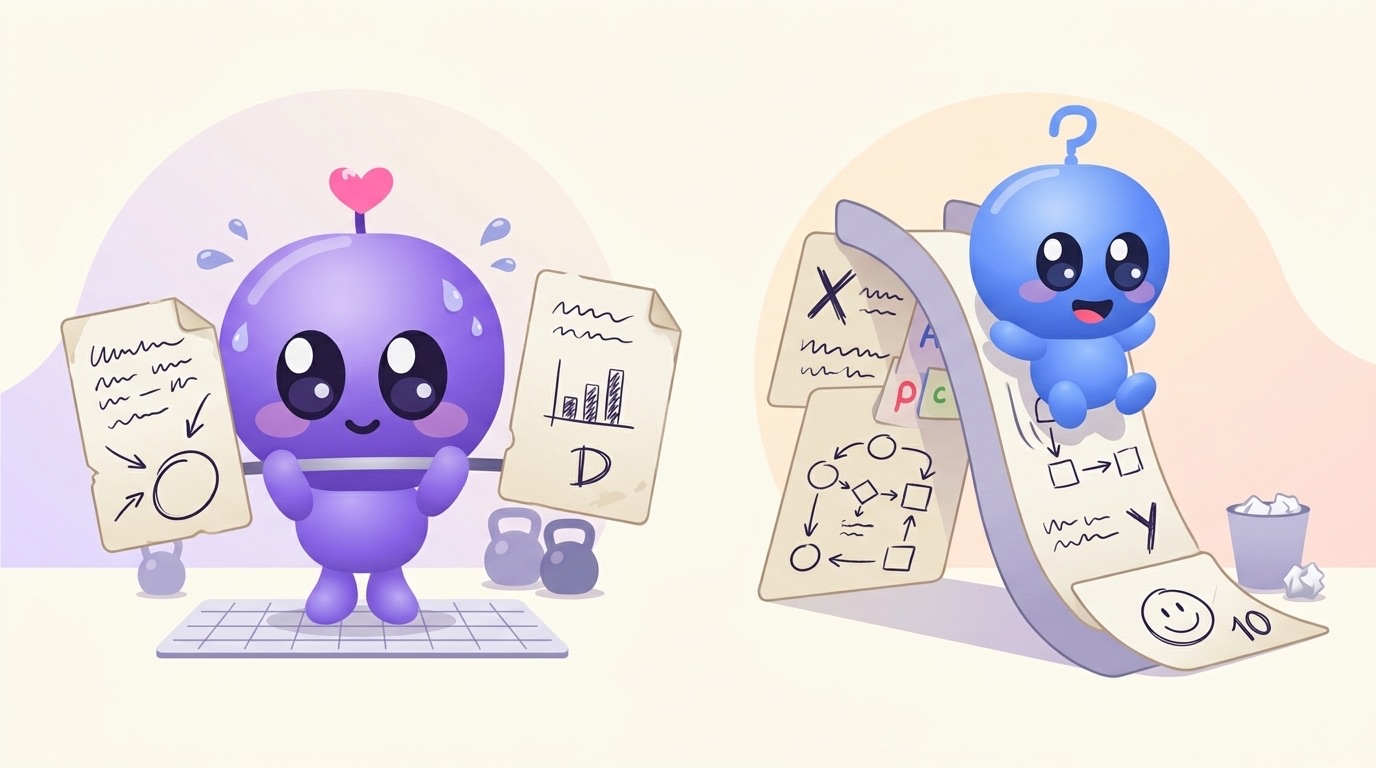
The simplest way I can put it: Quizlet is a playground and Anki is a gym.
Quizlet is friendly, quick and social. You can find a deck someone else made, play a matching game, and feel like you're getting somewhere. Anki is plain, a bit intimidating, and built around one thing: showing you each card at the exact moment you're about to forget it. It's less fun and it works better.
So: use Anki if you're memorising a lot over months or years (medicine, law, languages) and you're willing to spend an hour learning it. Use Quizlet if your test is soon, the material is standard, and you want something easy. And if your real problem is making the cards in the first place, neither one fixes that.
Side by side
| Quizlet | Anki | |
|---|---|---|
| Price | Free with caps; Plus around US$7.99/mo or US$35.99/yr | Free on desktop and Android; iPhone app US$24.99 once |
| Scheduling | Basic | The best there is, and tunable |
| Learning curve | Minutes | An evening |
| Shared decks | Enormous | Big community decks, especially for medicine |
| Making cards | By hand, AI on paid tiers | By hand, or add-ons |
| Card types | Text, images, audio | Everything, including cloze deletions |
Why Anki wins on memory
Anki's scheduler stretches the gap between reviews every time you get a card right and shrinks it when you get one wrong. In practice that means you see easy cards rarely and hard cards often, so you spend your time where you're weakest. Over a long course, that adds up to far fewer total reviews for the same retention. How spaced repetition works.
It also gives you control. Cloze deletions ("The ___ nerve innervates the diaphragm") are especially good for dense material, and there's an add-on for almost anything.
The price is setup time. A lot of people quit in the first week because building decks feels like a second unit.
Why Quizlet wins on starting
You can be studying in two minutes. For a common course there's almost certainly a deck already, and the games break up the monotony.
The trade-offs: more of it sits behind Plus every year, Plus still caps some features, and shared decks are often made for someone else's course (and sometimes just wrong).
The problem neither solves
Someone still has to turn a 60-slide lecture into good cards. By hand that's about an hour per lecture. Using a shared deck saves the hour but rarely matches what your lecturer emphasised, which is what the exam is written from.
That's the gap AI study tools fill. With The Study Mill (which I build), you upload the week's slides or recording and get flashcards, plus a short lesson, a quiz with written answers that get marked, and an audio walkthrough. You can study there, or treat the cards as a first draft for your own system.
Which should you use?
- Medicine, law or a language, long horizon: Anki. Use an AI tool to draft cards faster.
- Test in a few weeks, standard material: Quizlet.
- Your exam asks you to explain, not just recall: flashcards alone won't get you there. Practise writing answers. Why that works.
Skip the card-making
Upload one lecture and see the flashcards and quiz it builds in about a minute. Free, no card needed.
More comparisons: Quizlet vs Knowt · AI alternatives to Anki
Quizlet and Anki pricing are as published in October 2026 and change. Check their own sites.