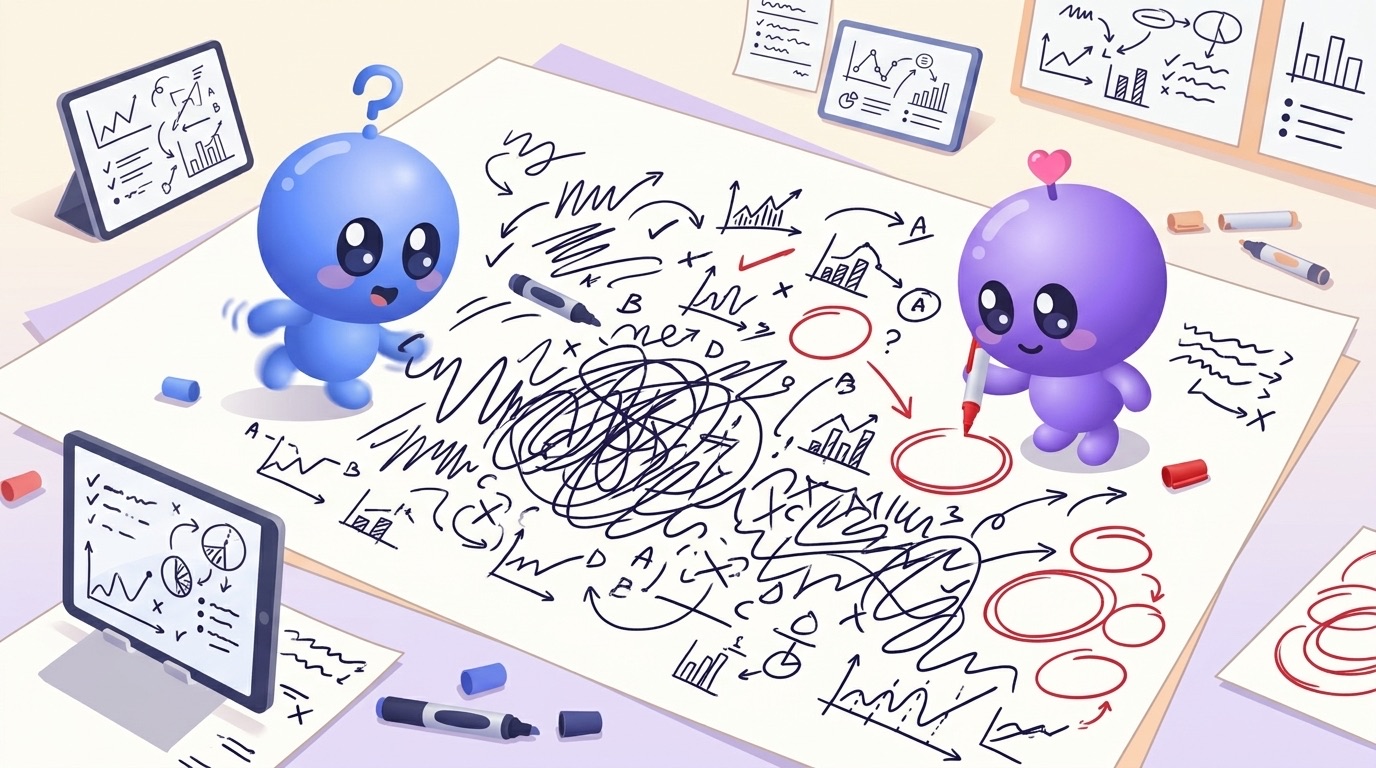
You've read the week's slides on heart failure twice. They feel familiar. So you take a blank page, close the laptop, set a timer for ten minutes and write down everything you can remember. After four lines you stop. You know there was something about preload. You can't say what it was.
That's blurting. You write everything you remember about a topic from memory, then check the page against your notes and mark what you got wrong and what you left out. It works because it's retrieval practice, one of the best supported findings in learning research, and because the blank spots on the page show you exactly where to spend your next hour. It's popular on study TikTok, but the idea underneath is old and solid.
How to blurt, step by step
1. Pick a small chunk. One lecture, or one section of one. "Week 4: heart failure" works. "All of cardiology" doesn't. If the chunk is too big you run dry after a few minutes and start guessing.
2. Read or listen to it once, properly. Blurting tests what went in. If you've never understood the material, a blank page just tells you that you haven't studied yet.
3. Close everything. Notes, slides, phone. Put them somewhere you can't glance at them.
4. Write everything you can remember. Set a timer for 5 to 15 minutes. Dot points, arrows, rough diagrams, half sentences. Don't tidy it. When you stall, sit with it for a minute before giving up, because that struggle to fetch something is the part that strengthens the memory.
5. Check it in a different colour. Open your notes and go through line by line. This is the step people skip, and it's where most of the value is.
6. Study the gaps, then blurt again later. Not straight away. Tomorrow, or in a few days, do the same topic on a fresh page.
The checking step is the whole point
A blurt page with no checking is just a page of writing. The checking turns it into a map.
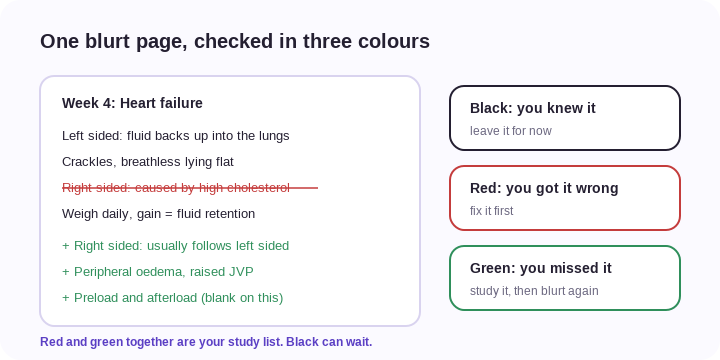
I'd use three colours. Leave what you got right in black. Mark anything wrong in red, and add anything you missed in green. Wrong answers matter more than missing ones, because a confident mistake will happily walk into the exam with you. A gap at least knows it's a gap.
When you've finished, the red and green lines are your study list for that topic. Not the whole lecture again. Just those lines. That's where blurting saves time compared with rereading everything from the top.
Why it works
Two things are going on.
It's retrieval practice. Pulling information out of memory strengthens it more than reading it again does. Rereading builds familiarity, and familiarity feels like knowing. Producing it from a blank page is a different and harder skill, and it's the one the exam asks for. I've written more about that in active recall vs rereading.
A well known study by Jeffrey Karpicke and Janell Blunt, published in Science in 2011, put this to the test. Students who read a science text and then practised writing down what they could recall did better on a test a week later than students who studied it repeatedly or built detailed concept maps with the text in front of them. That recall practice looked a lot like blurting.
It's honest feedback. Most study methods let you fool yourself. Highlighting feels productive. Nodding along to a lecture recording feels productive. A blank page can't be fooled. If you can't write it, you can't write it.
The mistakes that waste a blurt
Blurting too much at once. A whole unit on one page turns into a vague list of headings. Keep it to one lecture or less.
Peeking. Even one glance at the slides turns it back into copying. If you're stuck, write "something about preload??" and move on. That question mark is useful information.
Skipping the check. Covered above, but it's the most common one. Without it you've only found out how much you wrote, not what you know.
Blurting before you've learnt anything. Early in the semester, a blank page about a topic you haven't covered just makes you feel bad. Learn it first, then blurt.
Using it for the wrong kind of subject. Blurting suits material you need to explain: pathophysiology, psychology theories, legal principles, economics concepts. It's weaker for skills you need to perform. You can't blurt your way to solving a drug calculation or an integral. For those, do practice problems.
Blurting vs flashcards vs the Feynman technique
They're all forms of active recall, and they work well together.
| Method | Best for | What it tells you |
|---|---|---|
| Blurting | Seeing how a whole topic hangs together | Which parts of a topic are missing or wrong |
| Flashcards | Specific facts, terms, drug names | Exactly which fact you can't recall |
| Feynman technique | Deep understanding of one concept | Where your explanation goes vague |
A neat routine: blurt a topic, turn the green and red lines into flashcards, and use the Feynman technique on the one concept that left you totally blank. Then come back and blurt the topic again in a few days, following a spaced repetition schedule so each attempt lands just as you're starting to forget.
A version you can do out loud
You don't need paper. Talking through a topic from memory on a walk is blurting with your voice. It's harder to check afterwards, so it works best when someone asks you questions and tells you what you missed.
That's part of why I built The Study Mill the way it is (I'm biased, obviously). You upload a week's slides, notes or a lecture recording. In Walk & Learn, Milli and Luke teach the week as audio and ask you questions you answer out loud, and the quiz mixes multiple choice with written answers that the AI marks against your own material. Questions you miss come back in your daily review, which does the "check, then come back later" part for you. The free plan covers 2 classes. A pen and a blank page are still free, though, and they work.
Try it tonight
Pick one lecture from this week. Read it once. Close it. Ten minutes on a blank page, then check it in red and green. Whatever ends up coloured is what you study tomorrow, and nothing else.
If you'd like the questions written for you, upload that same lecture to The Study Mill and see what it asks.