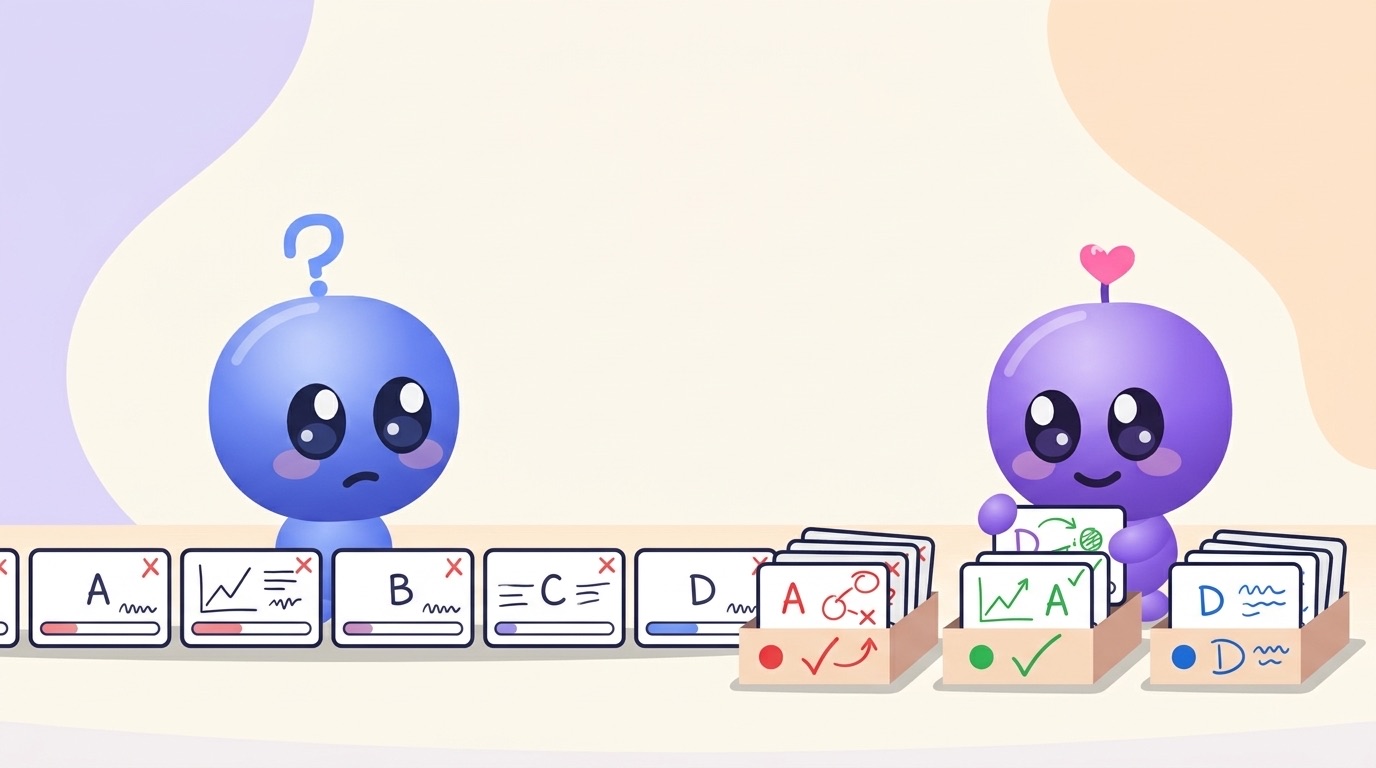
You open the unit page and count. Week 4, week 5, week 6, week 7. Four lectures you meant to watch, each an hour or more, plus tutorial prep, plus this week's lecture, which is tomorrow. The maths says you need a free weekend you don't have. So you open week 4, watch twenty minutes, feel no closer, and close the tab.
To catch up on missed lectures, don't work through them in order at normal speed. Keep up with the current week first, so the pile stops growing. Then sort the missed weeks by what's assessed soonest and what later topics depend on, quiz yourself on each one before you watch it, and only rewatch the parts you can't answer. Played at 1.5x or 2x, a recording takes half to two thirds of the time, and research suggests you lose little or nothing for doing it.
First, stop the pile growing
The instinct is to go back to week 4 and work forward. The trouble is that while you're doing week 4, week 8 happens, and now you're behind on that too. Students who catch up from the oldest lecture often stay exactly as far behind as they started.
So the first rule is boring: go to this week's lecture (or watch it within a day or two) and do the tutorial prep, as if you were up to date. That caps the backlog at its current size. Every hour you spend on old weeks after that actually shrinks it.
There's a second reason to do this. Later lectures often recap earlier ones, and tutorials tend to show you which ideas matter. Being present for the current week gives you a map of what the old weeks were building towards.
Sort the missed weeks into three piles
Not every missed lecture deserves the same effort. Open the unit outline and the assessment schedule, then sort each missed week into one of three piles.
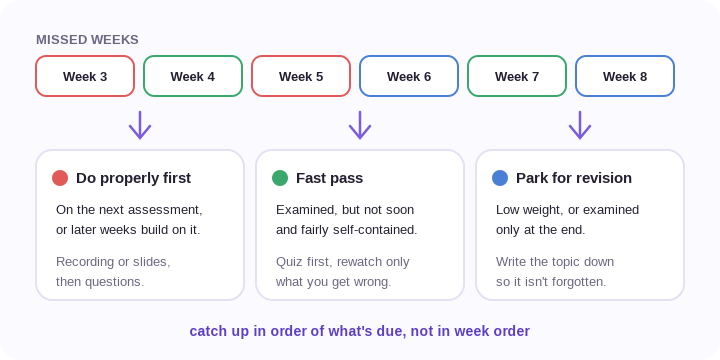
Do properly first. Weeks that are on the next assignment, quiz or mid-semester exam, and weeks that later topics build on. In a physiology unit, the week on membrane potentials is in this pile even if it isn't assessed next, because the nerve, muscle and heart lectures all assume it. In law, the week that sets up a doctrine is in this pile because the following weeks apply it.
Fast pass. Weeks that will be examined but not soon, and that stand fairly well on their own. You still need them, just not this week.
Park for revision. Low-weight topics, or content only examined in the final. Write down what each one covers so it doesn't vanish, then leave it until your revision plan reaches it.
This step takes about fifteen minutes and usually turns "seven weeks behind" into two or three weeks of urgent work. That's a number you can do something about.
Quiz first, then watch
For any missed lecture, the slowest approach is to press play and listen to the whole hour. A faster one is to find out what you already know before you start.
Open the slides and turn each content slide into a question. "What are the signs of left-sided heart failure, and why does lying flat make breathing worse?" is a better starting point than the slide heading. Try to answer each one with the slides hidden. You'll know some from tutorials, readings or common sense. The ones you can't answer are the parts of the recording worth your time. I walk through this method in detail in how to revise from lecture slides.
Trying to answer before you've learned something feels backwards, but it helps. Attempting a question first and then being shown the answer tends to lead to better memory than just reading the answer, even when your first attempt is wrong. Researchers call it the pretesting effect, and it's a cousin of the testing effect that makes quizzing yourself so useful in the first place.
Watch at 1.5x or 2x, with a plan
Speeding up a recording is the obvious shortcut, and it holds up better than you might expect. In a study by Murphy and colleagues at UCLA, students who watched a lecture at 1.5x or 2x did about as well on a test as students who watched at normal speed, both straight away and a week later. Performance dropped at 2.5x.
Two caveats. That was a lab study using pre-recorded lecture videos, not a full semester, and dense technical content, like a pharmacology lecture or a worked calculus proof, may need you to slow down or pause. And the time you save is only useful if some of it goes into testing yourself afterwards. Watching four lectures at 2x and quizzing yourself on none of them leaves you roughly where you started, just with a sense of progress.
A practical approach for a "do properly" week:
- Write your questions from the slides and try them (about 20 minutes).
- Watch the recording at 1.5x to 2x, slowing down for the parts you couldn't answer.
- Close everything and answer the questions again, out loud or on paper.
- Put the ones you missed somewhere you'll see them in two or three days.
If you'd rather not sit through recordings at all, this post on turning lecture recordings into notes covers working from a transcript instead.
Fit it around the current week
Catching up works best in short, regular blocks rather than one heroic weekend. Spacing study across several days leads to better memory than doing the same hours in one go, and it's far easier to actually do. One "do properly" week per day is a reasonable pace for most students: about an hour, often in two sittings.
If you work, have placement or care for someone, the same idea applies at a smaller scale. How to stay on top of a semester when you work part-time has a week plan built around shifts. Use the dead time on buses and in breaks for re-answering questions, and save free afternoons for the weeks that need a recording.
Tell your tutor or lecturer you've fallen behind if it's more than a couple of weeks, especially if illness or something at home was the cause. Most unis have special consideration or extension processes, and staff can usually tell you which weeks matter most for the next assessment. That's information you'd otherwise be guessing at.
Where an app fits
I build The Study Mill, so I'm biased, but catching up is a job it handles well. You upload a missed week's slides, PDF or recording, and it turns that week into short lessons, flashcards and a quiz mixing multiple choice with written answers marked by AI, all from your own material. You can take the quiz first to see which parts of the lecture you need, which is the quiz-first method above without writing the questions yourself. Walk & Learn has two hosts, Milli and Luke, teach the week back to you as audio and ask you questions to answer out loud, which suits a commute when you're behind. Daily review then brings back the questions you missed.
To be fair about it, writing your own questions is useful practice, and if you only upload slides it can only work from what's on them, so add the recording where you have it. The free plan covers 2 classes; Pro adds unlimited classes, exam mode and cram sheets.
Start with one week tonight
Go to this week's lecture as normal. Then pick the missed week that's assessed soonest, write a question for each slide, try them, and watch only what you couldn't answer. Or upload that one week to The Study Mill and take its quiz before you press play. One week caught up properly is worth more than four half-watched.