
You finish a close at 10pm, smell like coffee grounds, and remember the week 6 pharmacology lecture you haven't watched. Then the week 7 one goes up. By the time the roster gives you a free Saturday, you're four lectures behind and you spend the whole day watching recordings at double speed.
If you work part-time, the way to stay on top of a semester is to stop relying on big study days and build a small, fixed routine around your shifts. Review each lecture within a day or so of it happening, even for 20 minutes. Put short reviews (flashcards, a few questions) into the gaps a shift leaves, save your free days for the hardest topics, and do one weekly catch-up so nothing slides for more than a week. You don't need more hours. You need the hours you have to happen every week.
You're not unusual, and the hours matter
Most Australian uni students do paid work. In Universities Australia's 2017 student finances survey, more than four in five students had a job, and a growing share of full-time students were working over 20 hours a week. So the problem isn't you being disorganised. It's a timetable that assumes you have more free time than you do.
The research on how much work hurts grades is mixed. Many universities suggest keeping it to about 15 hours a week during semester, and some studies find students past that point are more likely to miss deadlines. Other studies find moderate hours make little difference, or even go with slightly better grades, perhaps because a job forces some structure into the week. The honest summary is that a few shifts a week are very workable, and long hours make it much harder. If you have any choice over your roster, protect the weeks before exams.
Why big catch-up days fail
The usual plan is "I'll catch up on my day off." It fails for two reasons.
The first is that the day off rarely stays free. Someone calls in sick, you pick up the shift, and the catch-up moves to next week.
The second is that one long session is a poor way to learn, even when it happens. Spreading the same study time across several days leads to much better memory than doing it in one block. That's the spacing effect, one of the most reliable findings in learning research, and I covered it in how long should you study for. Five 30-minute sessions across the week will beat one two-and-a-half-hour Saturday, and they're also far easier to fit around a roster.
A week built around shifts
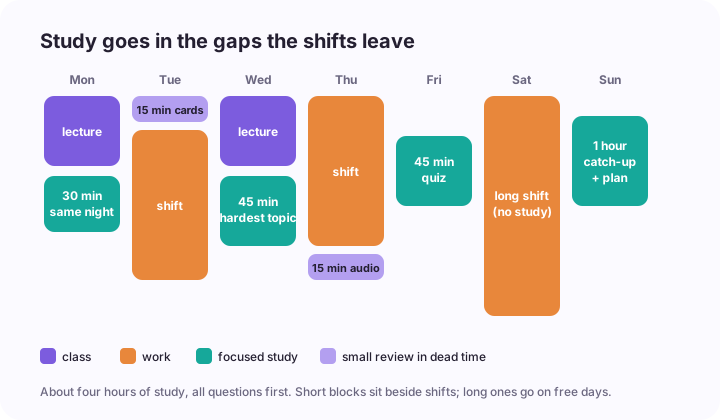
The shape matters more than the exact times. A few rules make it work.
Review every lecture within a day. The night of the lecture, or the next morning, spend 20 to 30 minutes on it. Not rewatching. Write down the main points from memory, then check your slides for what you missed. Material you look at again soon after first hearing it is much easier to hold onto than material you meet cold three weeks later.
Match the task to the gap. Fifteen minutes before a shift isn't enough for a law problem question, but it's plenty for flashcards. A 45-minute free evening is good for one hard topic. A whole free day is where past papers and assignments go. Most working students try to do hard thinking in tired 15-minute gaps and easy review on their precious free days, which is backwards.
Make dead time count. The bus to work, the walk to the car park, the ten minutes before your shift starts. These are good for quick retrieval: a stack of drug cards, five quiz questions, or an audio review you can answer out loud. They won't replace focused study, but they keep a topic warm between sessions.
Don't study after a long shift unless it's tiny. After eight hours on your feet in retail or on a ward placement, your brain is done. A five-minute flashcard round is fine. Starting a new topic usually isn't, and you'll redo it anyway.
Keep one weekly catch-up. Pick a slot you almost never work, often Sunday afternoon. Use the first half to catch anything that slipped and the second half to look at next week's roster and timetable and pencil in your study blocks. If your shifts change week to week, this ten-minute planning step is what stops the whole system falling over.
Questions first, always
When your study time is short, the method matters more than ever. Rereading slides and highlighting feel productive and do very little. Testing yourself is much more effective, because pulling an answer out of memory is what strengthens it. I compared the two in active recall vs rereading.
So start each block with questions. On a 30-minute lecture review, spend the first ten minutes writing what you remember and answering a few questions, then use the slides to fill gaps. On a quick commute review, it's all questions. Bring back the ones you get wrong a few days later, which is the idea behind a spaced repetition schedule.
Talk to people early
A few things that are easy to forget when you're busy:
- Tell your manager your exam dates early. Most workplaces that hire students expect it. Asking in week 2 for lighter shifts in exam weeks goes much better than asking the Friday before.
- Know your uni's extension and special consideration rules. Work commitments usually aren't grounds on their own, but if a roster clash turns into illness or a real crisis, you want to already know who to email.
- Ask about other tutorial times. If a tutorial clashes with a shift every week, ask your tutor whether you can attend a different stream.
Where The Study Mill fits
I build The Study Mill, so I'm biased, but this is a big part of why it exists. You upload a week's slides, notes or lecture recording, organised by class and week, and it turns them into short lessons, flashcards and a quiz that mixes multiple choice with written answers marked by AI. Everything comes from your own material, not generic content. The daily review brings back the questions you got wrong, so the spacing happens without you planning it.
Walk & Learn suits working students most. Milli and Luke teach your week as audio and ask you questions you answer out loud, so the walk to your shift becomes a review session. If you set an exam date, it plans revision around your timetable.
It isn't the right tool for everything. If your unit is mostly long reading for essays, you'll still need proper desk time. And the free plan covers two classes; unlimited classes and exam mode are on Pro.
Try it on one lecture
Take this week's lecture, the one you'll otherwise leave until the weekend. Tonight or tomorrow morning, give it 20 minutes: write what you remember, then check. Then do five questions on it before your next shift. If you'd rather have the questions and the audio made for you, upload that lecture to The Study Mill and try it on the way to work.