Four of you book a library room for two hours before the pharmacology exam. The first forty minutes go on placement stories. Then someone opens the week 7 slides on the big screen and starts reading them out. Everyone nods. You leave feeling like you studied, and on the bus home you realise you couldn't name a single side effect of a beta blocker.
A study group works when everyone does the learning alone first, and the group time is spent testing each other and explaining the answers people got wrong. Keep it to three to five people, agree on one topic before you meet, and give the session a fixed plan with a time for each part. Reading slides together is the one thing a group shouldn't do, because you can do it faster on your own and it gives nobody any feedback.
What a group does well, and what it does badly
There's decent research on both sides, and it shapes how a good session runs.
Discussing questions works. In a well known 2009 study in Science, Michelle Smith and colleagues looked at university biology students answering concept questions in class. Students answered alone, talked it over with their neighbours, then answered again. Their answers improved after discussion, and they also did better on a new question about the same idea, answered alone. The interesting part: this happened even in groups where nobody had the right answer to begin with. Arguing it out got them there.
Getting ready to explain works. Students who study a passage expecting to teach it to someone else tend to organise it better and remember the main points better than students who expect a test. John Nestojko, Robert Bjork and colleagues showed this in 2014, and the explanation they gave is that you study differently when you know you'll have to explain it. A study group gives you a real audience, so you get that effect for free. It's the same idea behind the Feynman technique.
Remembering together works badly. This one surprises people. When a group tries to recall a list or a topic out loud together, they remember less in total than the same people would if each wrote down what they remembered alone and then pooled it. Psychologists call it collaborative inhibition. The usual explanation is that hearing someone else's answer knocks you off your own way of retrieving things. So "let's go round the table and say everything we remember about heart failure" is a weaker activity than it looks.
The practical upshot: recall alone, then discuss together.
A 90 minute plan
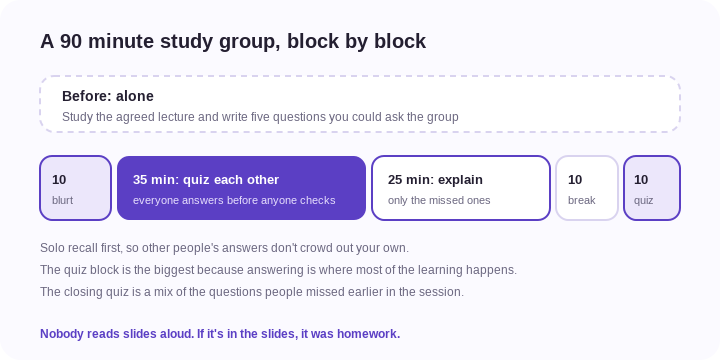
Before you meet. Agree on one lecture or one topic. Each person studies it alone and writes five questions they could ask the group. Short answer questions are best, because they make people produce an answer instead of picking one.
10 minutes: blurt alone. Everyone writes what they remember about the topic on a blank page, phones down. This gets each person's own recall done before anyone else's answers get in the way. The blurting method covers how to do it properly.
35 minutes: quiz each other. Take turns asking your questions. The rule that makes this work: everyone writes or says their own answer before anyone checks. If the first person to speak always answers, the quiet ones never retrieve anything.
25 minutes: explain the misses. Go back to the questions where people disagreed or got it wrong. Whoever got it right explains it, in their own words, without the slides. If nobody got it right, open the slides for that one point only, then have someone explain it back.
10 minutes: break. Actually leave the room.
10 minutes: closing quiz. Mix up the questions people missed earlier and ask them again. Finish on the hard ones, not the easy ones.
No slide reading at all. If the group needs the slides to answer most questions, the topic wasn't prepared, and the honest move is to end early and meet again later in the week.
Roles that stop it drifting
Groups drift because nobody is in charge of the clock. Give two jobs to two people, and rotate them each week so it doesn't always fall on the organised one.
The timekeeper runs the plan and calls time on tangents. A two minute catch-up at the start is fine. Forty minutes isn't.
The question master decides which question comes next, makes sure everyone answers before the reveal, and keeps a list of the ones the group got wrong for the closing quiz and for next week.
The rules worth agreeing on
- Come prepared or come anyway, but say so. Someone who hasn't studied can still answer questions and learn from the explanations. They just shouldn't be the one setting them.
- Three to five people. With two, you run out of questions. With seven, most people spend the session waiting.
- Same unit, same week. A mixed group of first years and third years spends most of the time on background.
- Wrong answers are the useful part. If one person always knows everything, they're probably not learning much from the group. Let them do the explaining, because that's where their benefit is.
- Meet regularly, not once. A weekly session on that week's lecture spreads the work out. One giant session before the exam turns into a cram.
When the group goes wrong
| What you see | What to change |
|---|---|
| Forty minutes of chat before starting | Start with the blurt. Chat in the break. |
| One person answers everything | Everyone writes an answer before anyone speaks. |
| Someone reading slides to the group | Make the slides homework. Open them only for disputed points. |
| Nobody brought questions | Spend the first 15 minutes writing questions alone, then swap. |
| Everyone confused by the same thing | Note it, ask your tutor, and move on rather than guessing together. |
Online groups
Video calls work fine with the same plan, and they're easier to fit around placement or part-time work. Two tweaks help. Use the chat box for answers during the quiz block so everyone commits before the reveal. And keep cameras on during the blurt, because a blank page is much easier to fake on a call.
Where The Study Mill fits
I build The Study Mill, so I'm biased, but it solves the "nobody brought questions" problem. Each person uploads their slides, notes or lecture recording for the week, and it turns them into short lessons, flashcards and a quiz that mixes multiple choice with written answers marked by AI, all built from that material and nothing else. Bring a few questions from your own quiz to the group. Afterwards, the daily review brings back the ones you missed, so the closing quiz carries on without the group. The free plan covers 2 classes.
It doesn't replace the group. The arguing over an answer is the part an app can't do for you.
Try it this week
Pick one lecture, message your group and agree on it. Everyone writes five questions before you meet. Then run the 90 minute plan once and see how much more you remember on the bus home. If you'd like a head start on the questions, upload that lecture to The Study Mill and see what it asks.