
The metabolism lecture usually arrives around week five. One slide holds the whole of glycolysis: ten steps, ten enzymes, a column of intermediates with names like 1,3-bisphosphoglycerate. The next slide is the citric acid cycle, then gluconeogenesis, then fatty acid oxidation. A lot of students respond the only way that seems possible, with a stack of flashcards for every enzyme in every pathway, and by week eight the stack has stopped meaning anything.
You don't need to learn pathways that way. For each pathway, learn its job first, then the few one-way steps that control it, then how hormones and the fed or fasting state switch it on and off. The other enzymes are mostly the pathway getting from one control point to the next, and they come much more easily once the frame is in place. Exam questions on metabolism lean heavily on the control and the logic, because that's what lets you reason about a patient, a drug or a deficiency.
This is general study advice. Your lecturer decides which enzymes and structures you need to know, so check your unit outline and past exam style.
Start with what the pathway is for
Before any enzyme, answer four questions in plain words. What goes in? What comes out? Where in the cell does it happen? When does the body want it running?
For glycolysis: glucose goes in, two pyruvate come out with a small amount of ATP and NADH, it happens in the cytoplasm, and it runs in almost every cell, faster when there's fuel to burn. For gluconeogenesis: pyruvate, lactate, glycerol and some amino acids go in, glucose comes out, it happens mainly in the liver, and it runs when you're fasting and blood glucose needs topping up.
Write these four lines for every pathway on your syllabus and put them on one page. That page is your map. When an exam question mentions a starving patient, a marathon runner or someone who has just eaten, the map tells you which pathways should be running before you think about a single enzyme.
Find the one-way steps
Most steps in a pathway are close to equilibrium and can run either way. A small number are effectively one-way, and those are almost always where the pathway is controlled. They are the steps worth learning in full: the enzyme, what activates it, what inhibits it, and why that makes sense.
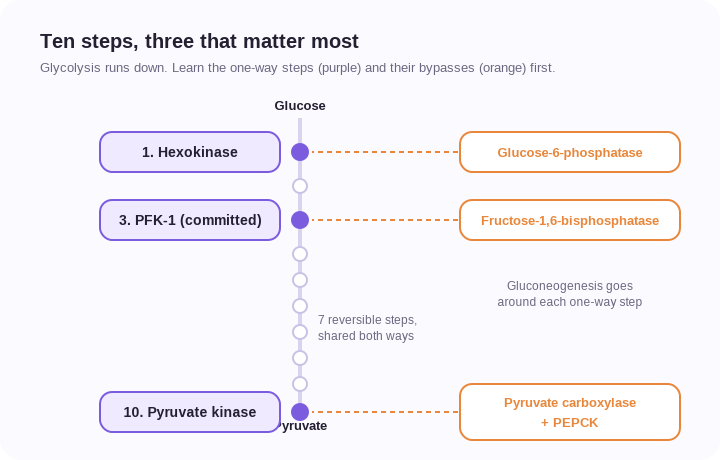
Glycolysis has three: hexokinase at the start, phosphofructokinase-1 (PFK-1) at step three, and pyruvate kinase at the end. PFK-1 is the committed step, the point after which glucose is headed down the pathway. It's switched on by AMP (the cell is low on energy) and switched off by ATP and citrate (the cell has plenty). Read that out loud and it stops being a fact to memorise. A cell low on energy speeds up the pathway that makes energy.
Gluconeogenesis then becomes simple. It reuses the seven reversible steps of glycolysis in reverse and goes around the three one-way steps with its own enzymes: pyruvate carboxylase and PEPCK, fructose-1,6-bisphosphatase, and glucose-6-phosphatase. Glucose-6-phosphatase is mainly found in the liver (and kidney), which is why the liver can release glucose into the blood and muscle can't. One fact, and a whole family of exam questions answers itself.
Do the same for every pathway: find the committed step, learn its regulators, and ask why each regulator makes sense for the cell.
Learn the fed and fasting switch
The biggest idea in metabolism is that the body runs in roughly two modes. After a meal, insulin is high and the body stores fuel: glycolysis, glycogen synthesis and fat synthesis run. When fasting, glucagon is high and the body releases fuel: glycogen breakdown, gluconeogenesis, fat breakdown and, in a long fast, ketone production.
Make a two-column table with "fed" and "fasting" at the top and every pathway you've covered sorted into one side. Pathways that do opposite things sit in opposite columns, and they are usually controlled together so they don't run at full speed at the same time, which would waste energy for nothing. Fructose-2,6-bisphosphate is the classic example: it pushes PFK-1 on and fructose-1,6-bisphosphatase off at once.
Once the table exists, many questions become a lookup. Why does a person with untreated type 1 diabetes produce ketones? Without insulin the body behaves as if it's fasting, even with plenty of glucose in the blood. If you like following that kind of chain to the bedside, it's the same method as in how to study physiology.
Draw it from a blank page
Recognising a pathway on a slide and producing it are different skills. Once a week, take a blank page and draw a pathway from memory: inputs, outputs, location, the control points with their regulators, and where it connects to other pathways. Then check it against your notes and mark what you missed in a different colour.
The first attempt will be patchy. That's the useful part, because the gaps show you exactly what to revise. Testing yourself like this beats rereading by a long way, which I've written about in active recall vs rereading.
Keep the drawings small and rough. You're not making a poster. Over a few weeks, start joining pathways together on one page, with acetyl-CoA in the middle, since it's where carbohydrate, fat and protein metabolism meet.
Ask "what if this enzyme stopped working?"
Biochemistry exams love deficiencies, poisons and drugs, because they test whether you understand the pathway or just recognise it. Practise by picking an enzyme and predicting what builds up before it, what runs short after it, and what the body might do instead.
If pyruvate dehydrogenase is impaired, pyruvate can't easily enter the citric acid cycle, so more of it is turned into lactate. If glucose-6-phosphatase is missing, the liver can't release glucose, so fasting causes low blood sugar. You don't need every disease name to reason like this. You need the map and the control points, and the reasoning gets you most of the way.
Mixing these questions across pathways, rather than doing all of glycolysis then all of the citric acid cycle, is harder and works better. Interleaving explains why.
A weekly rhythm
| When | What | Time |
|---|---|---|
| After the lecture | Write the four-line summary for each new pathway | 10 min |
| Same week | Learn the committed step and its regulators | 20 min |
| Next day | Add the pathway to your fed or fasting table | 10 min |
| End of week | Draw it from a blank page, then check | 20 min |
| Weekly | Five "what if this enzyme stopped?" questions | 20 min |
Where The Study Mill fits
I build The Study Mill, so I'm biased. Upload your biochemistry slides or lecture recording each week and it turns your lecturer's own material into short lessons with analogies, flashcards and a quiz. The quiz mixes multiple choice with written answers marked by AI, which suits "what happens if this enzyme fails" questions. Missed questions come back in daily review, and Walk & Learn has Milli and Luke talk the week through as audio and ask you questions you answer out loud.
It won't draw your pathways for you, and the drawing is where a lot of the learning happens. The free plan covers 2 classes, enough to try it on biochemistry alongside one other unit.
Pick one pathway from this week's lecture. Write its job in four lines, find its committed step, and say out loud why its regulators make sense. Whatever you can't explain is your next study session.