Week four of a physiology unit. You've just finished the cardiac cycle, with its pressure curves, valve sounds and a Wiggers diagram that has six lines stacked on top of each other. Next week is the kidney, and the week after that is respiration. Each one feels like a brand new subject with its own vocabulary, and by mid-semester you're trying to hold four separate textbooks in your head.
Physiology gets much easier once you notice it isn't four subjects. The same few ideas run through every system: variables held steady by feedback loops, things flowing down gradients, and structure matching function. Learn those ideas properly, read each new system through them, and practise predicting what happens when something changes. That last part matters most, because predicting is what physiology exams ask you to do.
Physiology is a handful of ideas on repeat
Physiology educators have studied this. Joel Michael, Harold Modell and colleagues surveyed physiology teachers and published a set of core concepts that run through the whole discipline. Homeostasis and flow down gradients sit near the top of that list. The idea is that seeing these recurring patterns makes each new system easier to learn.
So when a new system arrives, don't start with its details. Start by asking which of the big ideas it's an example of.
1. Learn one feedback loop until it's boring
Most of what your unit covers is some variable being held near a set point: blood pressure, body temperature, blood glucose, calcium, plasma osmolality, blood gases. Every one of them is controlled by a negative feedback loop with the same parts.
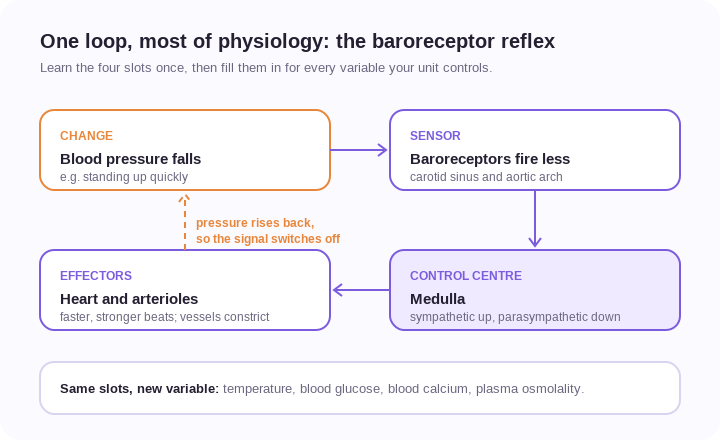
Take the baroreceptor reflex. You stand up quickly, blood pools in your legs and blood pressure falls. Stretch receptors in the carotid sinus and aortic arch fire less. The cardiovascular centre in the medulla notices, raises sympathetic output and lowers parasympathetic output. Your heart beats faster and harder, your arterioles constrict, and pressure comes back up. Once it's back, the response winds down.
Now the trick. Make a blank template with four boxes (change, sensor, control centre, effectors) and fill it in for every controlled variable in your unit. Temperature has thermoreceptors, the hypothalamus, and sweating, shivering or changes in skin blood flow. Blood glucose has the pancreas acting as sensor and control centre at once, with insulin and glucagon as the messages. After three or four of these, a new hormone stops being a new thing to memorise and becomes a new way of filling in slots you already know.
Keep a short separate list for the exceptions: positive feedback loops like the oxytocin surge in labour or the clotting cascade. They stand out precisely because they don't switch themselves off.
2. See every flow as gradient over resistance
Blood moving through vessels, air moving into the lungs, oxygen crossing the alveolar wall, water moving between compartments. These are all the same idea: something moves from high to low, and how much moves depends on the size of the difference and how hard it is to get through.
Flow equals pressure gradient divided by resistance. Once that sits in your head, a lot of content stops needing separate memorisation. Resistance in a tube rises steeply as the radius shrinks (with the fourth power of the radius), which is why a small amount of arteriole constriction changes blood pressure so much, and why narrowed airways in an asthma attack make breathing so hard. Diffusion across a membrane depends on the gradient, the surface area and the thickness, which tells you why emphysema (less surface) and pulmonary oedema (thicker barrier) both impair gas exchange.
When a lecture introduces a new movement of anything, ask three questions. What's the gradient? What's the resistance? What would change either one?
3. Read the graphs as stories
Physiology loves graphs, and exams love asking you to shift them. The oxygen-haemoglobin dissociation curve, the Frank-Starling curve, the action potential, pressure-volume loops. Students often memorise the shape and stop there.
Instead, for each graph, be able to say in plain words what each axis means, what one point on the line means, and what moves the line. On the dissociation curve, a right shift means haemoglobin lets go of oxygen more easily. More carbon dioxide, more acid, a higher temperature and more 2,3-BPG all push it right. That makes sense once you picture working muscle: hot, acidic and full of carbon dioxide, which is exactly where you'd want oxygen released.
Then practise drawing the graph from a blank page and adding the shifted line yourself. If you can only recognise a graph, you don't know it yet. The gap between recognising and recalling is the same one I wrote about in active recall vs rereading.
4. Practise predicting, not describing
The single best physiology habit is the "what happens if" question. What happens to heart rate if someone loses a litre of blood? What happens to breathing if arterial carbon dioxide rises? What happens to urine output if ADH is blocked?
Answer each one as a chain of steps and check every step against your notes. Describing a system and reasoning with it are different skills, and exams test the second. If you can't think of a sensible "what if" for a topic, you probably haven't found the mechanism yet.
This habit is also your bridge to the next unit. Pathophysiology is what happens when one of these loops breaks, and if you can predict normal responses you'll find disease far easier. The method in how to study pathophysiology picks up exactly where this leaves off.
5. Link the systems on purpose
Lectures teach one system at a time. Your body doesn't run that way, and the better exam questions don't either. Haemorrhage involves the heart, the vessels, the kidneys and several hormones at once. Exercise pulls in the lungs, the muscles, the heart and temperature control.
Once a few systems are covered, spend one session a week on a scenario that crosses them. Write out what each system does and in what order. It feels slow, but this is where scattered facts turn into one picture. Anatomy helps here too: knowing where the structures are, as in how to study anatomy, makes it easier to picture where a signal starts and ends.
A weekly rhythm
| When | What | Time |
|---|---|---|
| Before the lecture | Skim the slides and ask which big idea this is | 10 min |
| Same day | Fill in the feedback template or flow questions | 20 min |
| Next day | Redraw one graph from memory, then shift it | 15 min |
| Later in the week | Answer five "what happens if" questions | 20 min |
| Weekly | Work one scenario across two systems | 25 min |
This is general study advice, not clinical guidance. Use your own course materials and lecturers for the content itself.
Where The Study Mill fits
I build The Study Mill, so I'm biased. If your physiology unit comes as lecture slides or PDFs, you can upload each week and it turns your lecturer's own material into short lessons with analogies, flashcards and a quiz. The quiz mixes multiple choice with written answers marked by AI, which suits "what happens if" questions better than multiple choice alone. Missed questions come back in daily review, and Walk & Learn has Milli and Luke talk the week through as audio and ask you questions you answer out loud, which is a decent way to rehearse a feedback loop on a walk.
It won't redraw your graphs for you, and you shouldn't want it to. The free plan covers 2 classes, enough to try it on physiology and one other unit.
Take one controlled variable from this week's lecture and fill in the four boxes from memory. Then ask yourself what happens if one of them stops working. Whatever you can't answer is your next study session.