
Open a pathophysiology lecture on heart failure and you'll usually find a slide with two columns. Left-sided: dyspnoea, orthopnoea, crackles, frothy sputum. Right-sided: peripheral oedema, raised JVP, hepatomegaly, ascites. Most students copy both columns and try to memorise them as two lists. Then the exam asks why a patient with left-sided failure eventually develops right-sided signs, and the lists have nothing to say.
The fix is to learn each condition as a mechanism instead of a list. Start from the normal physiology, work out what breaks, and follow the consequences one step at a time until you reach the signs, symptoms and test results. If you can rebuild the chain from cause to symptom without notes, you don't need to memorise the symptom list at all, because you can work it out. And that's what exam questions are really testing.
Why the list approach falls apart
Symptom lists feel efficient. The trouble is that pathophysiology exams rarely ask you to recite a list. They give you a patient and ask what's happening, what you'd expect to see next, or why a treatment works.
A list can't answer "why". A mechanism can. If you know the left ventricle is failing to pump forward, blood backs up into the lungs. Back pressure in the pulmonary circulation pushes fluid into the alveoli, which gives you crackles and breathlessness. Lying flat brings more blood back to an already struggling heart, so the patient props themselves up on pillows. Over time, the raised pressure in the lungs makes the right ventricle work harder until it fails too, and now fluid backs up into the body instead. Every item on both columns of that slide falls out of one idea: fluid backs up behind the side that's failing.
1. Revise the normal physiology first
Pathophysiology is physiology going wrong, so you can't follow the wrong turn if you don't know the road. Before a pathophysiology topic, spend ten minutes on the normal version. Before diabetes, revise what insulin does. Before acute kidney injury, revise what the nephron filters and reabsorbs. Before shock, revise how cardiac output and blood pressure are maintained.
This also tells you where your real gap is. A lot of students who say "I don't get pathophysiology" have a physiology gap a unit back. The approach in how to study anatomy of tying every structure to its function helps here too.
2. Build a chain for every condition
For each condition, write the mechanism as a chain of boxes and arrows, one consequence per box. Keep each box short. The rule is that every arrow should be something you can explain in a sentence.
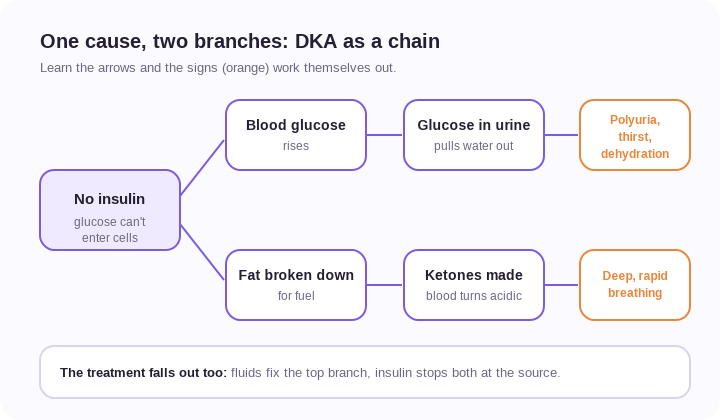
Take diabetic ketoacidosis. Without insulin, glucose can't get into most cells, so blood glucose rises. The kidneys can't reabsorb all of it, glucose spills into the urine and drags water with it, and the patient becomes polyuric, thirsty and dehydrated. Meanwhile the cells are starving, so the body breaks down fat for fuel, which produces ketones. Ketones are acids, so the blood becomes acidic, and the body tries to blow off carbon dioxide with deep, rapid breathing.
Now look at what that chain gives you for free. It explains the signs. It explains the treatment, because fluids fix one branch and insulin stops the other. You learnt one story and got the answers to half a dozen exam questions.
3. Ask "why" at every arrow
Once you have a chain, test it by asking why at each arrow. Why does the patient breathe deeply? Why does the glucose end up in the urine? If you can't answer, that arrow is a gap, and gaps are exactly where exam questions catch people.
Asking yourself why a fact is true has a name in learning research: elaborative interrogation. Its close cousin, self-explanation, means explaining to yourself how each step follows from the last. A well-known 2013 review of study techniques rated both as moderately useful, behind practice testing and spaced practice but well ahead of rereading and highlighting. They suit pathophysiology because the subject is made of causes and effects. The Feynman technique is a structured way to do this out loud.
4. Compare the conditions that get confused
Exams love conditions that look alike on the surface: type 1 and type 2 diabetes, DKA and hyperosmolar hyperglycaemic state, asthma and COPD, left and right heart failure, nephritic and nephrotic syndrome. Learn them in pairs once you know each one on its own.
A small comparison table works well. Put the mechanism in the first row, not the symptoms, because the differences in the signs come from the difference in the mechanism.
| Asthma | COPD | |
|---|---|---|
| Core mechanism | Airway inflammation and spasm that comes and goes | Lasting damage to airways and alveoli |
| Reversible? | Largely, with treatment | Only partly |
| Typical pattern | Episodes with triggers | Gradual, progressive breathlessness |
Fill in the table from memory first, then check it against your notes.
5. Test the chain, not just the facts
Flashcards still have a place in pathophysiology, but write them as questions about links rather than labels. "What are the signs of right-sided heart failure?" invites a list. "Why does right-sided heart failure cause ankle oedema?" makes you rebuild the mechanism.
Three formats work well:
- Blank chain: write only the cause, then rebuild every box and arrow from memory.
- Run it backwards: start from a sign (Kussmaul breathing, a low urine output) and trace it back to a cause.
- What if: change one thing and predict the result. What happens to the chain if the patient is also vomiting?
Testing yourself like this is the most consistently supported study method there is, and it beats reading over a neat diagram by a wide margin. More on why in active recall vs rereading. Spread the reviews over the semester, because pathophysiology builds on itself and you'll need cardiac and renal again when you reach pharmacology.
A weekly rhythm
| When | What | Time |
|---|---|---|
| Before the lecture | Revise the normal physiology | 10 min |
| Same day | Draw the chain for each new condition | 20 min |
| Next day | Blank chain from memory, then check | 15 min |
| Later in the week | Run two chains backwards from a sign | 15 min |
| Weekly | Compare one confusable pair | 20 min |
If you're a nursing student, add the next step to every chain: what would you do, and what would you watch for. That turns pathophysiology into the clinical reasoning your exams test later, which I cover in how to study for nursing exams.
This is general study advice, not clinical guidance. Follow your course materials and your lecturers for the content itself.
Where The Study Mill fits
I build The Study Mill, so I'm biased. If your pathophysiology unit comes as lecture slides or PDFs, you can upload each week and it writes short lessons with analogies, flashcards and a quiz from your lecturer's own material, not a generic disease list. The quiz mixes multiple choice with written answers marked by AI, which suits "explain why" questions. Missed questions come back in daily review, and Walk & Learn has Milli and Luke talk the week through as audio and ask you questions you answer out loud, which is a good way to rehearse a chain on the bus.
It won't draw your chains for you, and you shouldn't want it to. Drawing them yourself is where most of the learning happens. The free plan covers 2 classes, enough to try it on pathophysiology and one other unit.
Pick one condition from this week's lecture. Revise the normal physiology, draw the chain, and tomorrow try to rebuild it from a blank page. Whatever arrow you can't explain is what to study next.