
Picture the night before an intro accounting exam. You've reread the chapter on adjusting entries twice, highlighted the bits about accruals, and every worked example in the lecture slides makes sense as you read it. Then you open a practice question with a blank general journal underneath, and you can't work out which account to debit.
That gap is the whole story of accounting exams. The way to study for them is to do problems, not read about them: learn the accounting equation and the debit and credit rules until they're automatic, then work questions from a blank page, under time, and keep a log of every mistake and why you made it. Reading a solved example and understanding it is a different skill from producing one, and the exam only tests the second.
This is general study advice. Your unit outline decides what's assessed, and the standards and formats you're expected to use (AASB in Australia, for example) come from your lecturer.
Why rereading fails in accounting
Accounting looks like a reading subject because textbooks are thick and full of definitions. It behaves more like maths. The marks go to entries, schedules and statements you build yourself, and every one of them is a chain of small decisions: which account, which side, what amount, which period.
When you read a worked solution, all those decisions are already made. Your brain nods along, and the material feels familiar. That feeling of fluency is the trap I wrote about in active recall vs rereading. Familiarity tells you that you've seen it before, not that you can do it.
Learning research has a well known finding here, the worked example effect. Studying worked examples helps beginners, but mostly when each example is followed by a similar problem you solve yourself, and the support is gradually removed as you improve. So the slides and textbook examples are useful as a first step. They just can't be the last one.
Get the foundations automatic
Almost every first-year accounting question rests on two things.
The accounting equation. Assets equal liabilities plus equity. Every transaction keeps it balanced. If a business buys $5,000 of equipment on credit, assets go up by $5,000 (equipment) and liabilities go up by $5,000 (accounts payable). If you ever finish an entry and the equation doesn't balance, you've found your error before the marker has.
The debit and credit rules. Debits increase assets and expenses. Credits increase liabilities, equity and revenue. Each one decreases on the opposite side. Students who hesitate here lose time on every single question for the rest of the semester, so this is worth drilling until you can answer without thinking. Flashcards work well for it, and so does saying the rule out loud for each account in a trial balance.
Once those are automatic, the rest of the course becomes variations. Adjusting entries, depreciation, inventory and accruals are all "which accounts change, by how much, and in which period?"
Know where each number goes
A lot of exam questions are really asking whether you can follow a transaction through the system. It helps to see the whole path once.
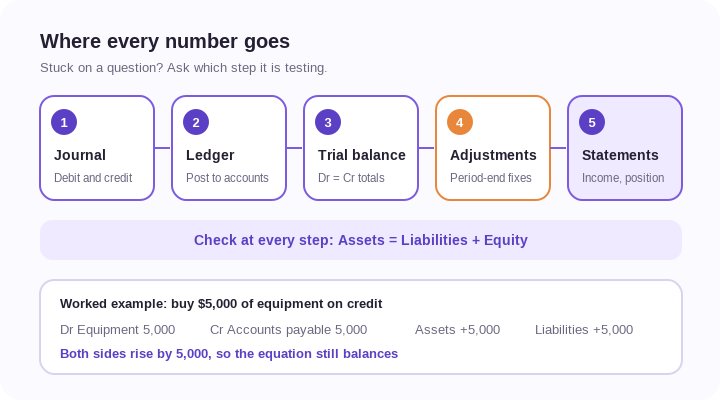
A transaction becomes a journal entry, gets posted to ledger accounts, the balances go into a trial balance, adjustments are made at period end, and the adjusted balances feed the financial statements. When you're stuck on a question, ask which step it's testing. A question about an unbalanced trial balance is about posting errors. A question about closing inventory is about adjustments and the income statement.
Practise from a blank page
This is the core of the method. Take a problem from your tutorial set or textbook, cover the solution, and do the whole thing on paper or in a blank spreadsheet. Only then check.
Some rules that make practice count:
Do the full question, not just the first part. It's tempting to do the journal entries and skim the statements. Exams usually chain the parts together, so errors early carry through, and you need practice spotting them.
Time yourself. Work out roughly how many minutes per mark your exam allows and practise to that. Accounting exams are often tight, and plenty of students who know the material run out of time.
Show your workings. Many accounting markers give method marks even when the final figure is wrong, but only if they can see the method. Label your calculations so a stranger could follow them.
Mix topics once you're comfortable. Doing ten depreciation questions in a row teaches you the method. Doing a depreciation question, then an accrual, then an inventory question teaches you to recognise which method a question needs, which is what the exam actually asks. That's interleaving, and accounting suits it well.
For later in semester, past papers are the best practice you can get, because they show you the format and the time pressure. I've compared the two in practice questions vs past papers. In short: topic questions while you're learning, full papers once you've covered the content.
Keep an error log
Every time you get something wrong, write down three things: the question, what you did, and the rule you missed. "Recorded prepaid rent as an expense instead of an asset" is useful. "Got question 3 wrong" isn't.
After a few weeks, patterns show up. Most students make the same handful of mistakes over and over: mixing up the direction of an adjustment, forgetting that accumulated depreciation is a contra asset, putting a balance sheet item on the income statement. Fix those few and your marks move more than another week of reading would.
Go back through the log the week before the exam and redo the questions you got wrong. If you can now do them cleanly, the error is gone.
Don't skip the theory questions
Many accounting exams include short answer or multiple choice theory questions: why we use accrual accounting, what a conceptual framework is for, the qualitative characteristics of useful information. They're easy to ignore because they feel softer than the calculations, but they're often the quickest marks on the paper.
Treat them like definitions you need to recall, not recognise. Write a two or three sentence answer from memory, check it against your lecture notes, and fix what you missed.
Where The Study Mill fits
I build The Study Mill, so I'm biased. You upload your accounting lecture slides, notes, PDFs or recordings, organised by class and week, and each week becomes short lessons with analogies, flashcards, notes, a tutor you can ask, and a quiz that mixes multiple choice with written answers marked by AI. Everything comes only from what you uploaded, so it uses your lecturer's terms and examples rather than a generic textbook's.
To be fair about the limits: it won't replace working full problems in a blank journal or spreadsheet. For that, your tutorial sets and past papers are better, and you should spend most of your practice time there. Where it helps is the foundations and the theory: drilling debit and credit rules until they're automatic, explaining concepts in your own words and getting told what you missed, and daily review that brings back the questions you got wrong. The free plan covers two classes; Pro adds unlimited classes, exam mode and cram sheets.
If you want to try it, upload the week on adjusting entries and see how many of the quiz questions you can answer without hesitating on which side is the debit.