
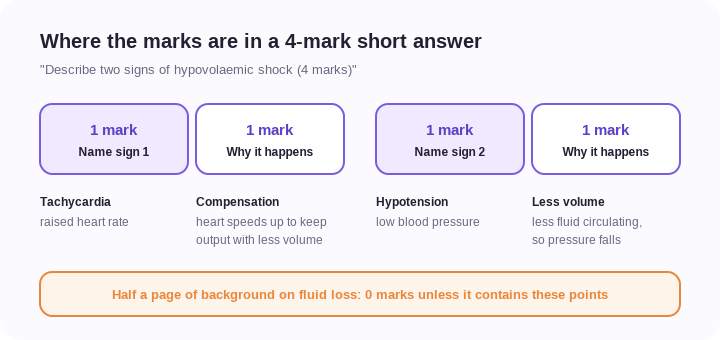
The question says "Describe two signs of hypovolaemic shock (4 marks)". You know this. You write half a page about fluid loss, blood pressure and the body's response, and you get 2 out of 4. When the paper comes back, the marker has circled "tachycardia" and written nothing else.
A short answer question is usually marked against a list of points, often one mark per point, sometimes with a mark for explaining each one. So to study for short answer exams, practise writing answers from memory (not recognising them), learn your content as specific points with a reason attached, and get used to reading the marks and the instruction word before you write. In the exam, give one clear point per sentence, use the correct term, and stop when you've covered what the marks ask for. Length doesn't earn marks. Points do.
How short answers are usually marked
Most short answer questions come with a marking guide. It varies by unit, but a common pattern looks like this: a list of acceptable points, a mark for each, and sometimes an extra mark for explaining or applying the point rather than just naming it. The marker reads your answer looking for those points. Anything else, however true, doesn't add marks.
That has a few practical consequences:
- The marks tell you how many points to make. Four marks for "two signs" probably means two signs, each with a short explanation. Two marks for "name two" means two words or phrases will do.
- A point buried in a long sentence can be missed. Markers are reading quickly through a stack of scripts. Make each point easy to find.
- The technical term matters. "Heart beats fast" might get the mark. "Tachycardia (raised heart rate, as the heart compensates for low circulating volume)" gets it every time and shows the reasoning too.
Your unit outline or tutor may describe the marking differently, so ask. Past papers with marking notes are the best evidence you'll get.
Read the instruction word first
"State", "describe", "explain" and "compare" ask for different answers, and the difference shows up in the marking guide.
- State or name: just the point. No explanation needed.
- Describe: what it is or what happens, with some detail.
- Explain: why or how. This is where students lose marks most often, because they describe when the question wanted the reason.
- Compare: a similarity or difference, with both things mentioned in the same sentence.
A psychology example: "Explain one limitation of a self-report questionnaire (2 marks)." "Participants may lie" gets one mark at best. "Participants may give socially desirable answers rather than honest ones, which reduces the validity of the data" gets both, because it says what happens and why it matters.
Study the points, not the page
Rereading your notes makes short answer exams feel easier than they are. The words look familiar, so you think you could write them. Then in the exam, with a blank space in front of you, you can't find the term.
That's the difference between recognising and recalling. I wrote about it in active recall vs rereading. A short answer exam is pure recall. Nothing on the page reminds you of the answer, so the only useful practice is practice that makes you produce it.
There's some research behind this. In classroom studies of quizzing, practising with short answer questions has sometimes given a bigger boost on later tests than practising with multiple choice, though not every study finds that difference. What is very well established is that testing yourself beats rereading, and short answer practice is about as close to the real thing as testing gets.
So when you study a topic, turn it into the questions an examiner would ask. For each one, write the points you'd need, and the reason behind each point. For a nursing pharmacology unit, that might be:
Q: Explain why patients on furosemide need their potassium monitored (2 marks). Furosemide is a loop diuretic that increases potassium loss in the urine (1). Low potassium can cause cardiac arrhythmias, so levels are checked to catch it early (1).
That's the whole answer. Two sentences, two points, each one easy to tick.
Practise by writing, from memory, against the clock
Once you have your questions, practise like this:
- Cover your notes and write the answer. By hand if the exam is handwritten.
- Mark it yourself against your points list, as strictly as a marker would. If the point isn't clearly there, it doesn't count.
- Note which points you missed and come back to those questions in a day or two, not the ones you got right.
- Time some of them. A rough rule many units use is about a minute or so per mark. Find out what yours is, then practise to it.
Mixing topics in one practice session helps too, because the exam won't tell you which lecture a question came from. My post on practice questions vs past papers covers when to save the real papers for a full timed run.
In the exam
- Count the marks, then plan the points. Jot the points in the margin before you write the sentences. It takes seconds and stops you rambling.
- One point per sentence. If it's a 4-mark question, four clear sentences is often enough.
- Use the question's words. If it asks about "risk factors", say "one risk factor is...". The marker sees the link straight away.
- Don't write everything you know. Extra material rarely earns marks and costs time you need for later questions. If you're unsure which point is wanted, one extra relevant point is fine. A paragraph of background isn't.
- Leave nothing blank. Even a correct term with no explanation can pick up a mark.
If a question has you frozen, move on and come back. I wrote more about what to do when your mind goes blank.
This is general study advice. Your unit outline, marking rubric and lecturer are the final word on how your exam is marked.
Where The Study Mill fits
I build The Study Mill, so I'm biased. You upload your own lecture slides, notes or recordings, organised by class and week, and each week becomes short lessons, flashcards, notes and a quiz. The quiz mixes multiple choice with written answers marked by AI against a model answer drawn from your material. The feedback says what you got right and gently notes what was missing. That's close to the practice loop above: write from memory, see the missing point. Daily review brings back the questions you got wrong.
To be fair about the limits: AI marking is a practice tool, not your marker. It's deliberately generous about wording and gives a right or wrong verdict, not a mark out of four, and it doesn't know your unit's exact rubric. So mark yourself strictly against past papers and your tutor's feedback too. The free plan covers two classes, which is enough to try it on a unit before an exam.
If you want to try it, upload one week of lectures, answer the written questions without looking, and see which points you leave out.