
You've got 40 minutes on the train each way. You open the week 5 pharmacology slides, read three of them, look up at your stop two stations later and realise you couldn't say what any of them were about. By Thursday you've given up and you're scrolling again.
The trick to studying on a commute is to use it for review, not for meeting material for the first time. Lectures and dense reading need a desk and your full attention. A commute is perfect for short, interruptible tasks that make you recall what you've already seen: flashcards and practice questions when you're seated, audio when you're walking or standing, and only light listening (or nothing) if you're driving. Done every day, two 30 minute trips add up to five hours a week of the kind of practice that sticks.
Why the commute suits review so well
Two of the most reliable findings in learning research line up with a commute almost perfectly.
The first is retrieval practice. Pulling an answer out of your memory strengthens it far more than rereading the same page. I've written about this in active recall vs rereading. A flashcard on the bus is retrieval. Reading slides on the bus mostly isn't.
The second is spacing. The same total study time spread over many short sessions beats one long session, especially for remembering things weeks later. A commute is a free, automatic spacing schedule: twice a day, five days a week, whether you planned it or not. If you want the long version, see how to space your reviews.
What a commute is bad at is anything that needs a long run of focus. Trains stop, people get on, your phone buzzes, you miss your stop. New, hard material punishes that. A deck of 20 flashcards doesn't care if you get interrupted at card 12.
Match the task to the trip
Not every commute is the same. The question is what your hands, eyes and attention are free to do.
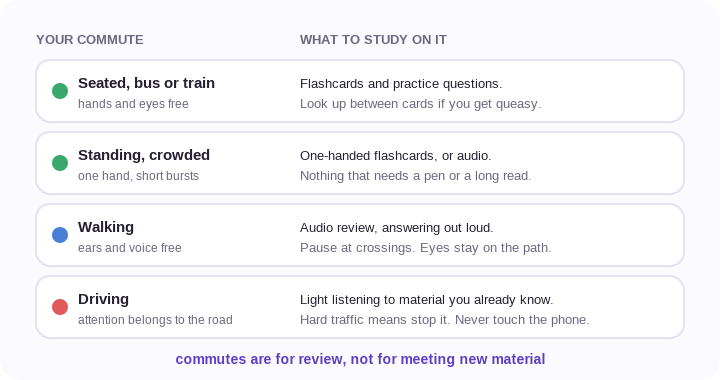
Seated on a bus or train. This is the best case. Do flashcards and practice questions, ideally ones from this week's lectures. Typing or scribbling a short answer before you check is stronger than just thinking "yeah, I know that".
Standing on a crowded train. You've got one hand and a lot of elbows. One-handed flashcards work, and so does audio. Skip anything that needs you to read a paragraph or write.
Walking or cycling to campus. Audio, with your eyes on the path. If you walk, talking answers out loud is fine and even helps. If you ride, keep one ear free or wait until you've parked the bike.
Driving. Be careful here. Research led by David Strayer at the University of Utah, funded by the AAA Foundation for Traffic Safety, found that hands-free voice tasks still add mental load and distraction behind the wheel. So if you drive, the most I'd suggest is light listening to material you've already studied, stopping whenever traffic gets busy, and never touching your phone. If that feels like too much, it is. Use the drive to rest.
Stop the carsickness
Reading in a moving vehicle makes a lot of people queasy. The usual explanation is sensory conflict: your inner ear feels the bus swinging around corners while your eyes, locked on a still screen, say you're not moving. Looking down makes it worse.
A few things help. Sit facing forward and near the front if you can. Hold the phone up closer to eye level rather than in your lap. Look out the window between cards so your eyes catch up with your body. Flashcards are kinder than reading here because each card is short and you naturally glance up between them. If you get sick no matter what, switch to audio. It removes the problem completely.
A simple commute plan for a normal week
This is the routine I'd suggest for a student with a 30 to 45 minute trip each way.
- Morning trip: 15 to 20 flashcards or questions from the last few weeks. Mix the weeks rather than doing one at a time.
- Afternoon trip, lecture days: a quick review of today's lecture. Close everything and try to list the main ideas from memory, then check your notes when you get home.
- Afternoon trip, other days: audio. Listen to a review of a week you've already covered, and pause to answer any questions in your head (or out loud, if you're walking).
- Friday: whatever you got wrong this week, again.
The important bit is that the lecture itself, the first proper pass through the material, happens somewhere you can concentrate. The commute is where it gets locked in. If you work as well as study, this fits neatly into the weekly system in studying while working part-time.
Make it frictionless
The commute you don't plan for becomes the commute you spend on your phone. A few small things make it easier to start.
Get it ready the night before. Download the deck or audio so a tunnel doesn't stop you. If you have to choose what to study once you're on the bus, you'll choose nothing.
Put it where your thumb goes. Move your study app to the spot on your home screen where your social app used to be. It sounds silly. It works for a lot of people.
Set a stop, not a timer. "Flashcards from my stop to Central" is easier to keep than "20 minutes of study", and you don't have to watch a clock.
Expect bad days. Some days the train is packed and you'll get three cards done. That's still three cards more than nothing, and the spacing still helps.
Where The Study Mill fits
I build The Study Mill, so I'm biased. The flagship feature, Walk & Learn, exists because of exactly this. You upload a week's slides, notes or lecture recording, and Milli and Luke teach that week back to you as a two-host audio session, asking you questions you answer out loud. It was built for walking, and it works on a bus or train if you don't mind talking quietly to yourself (or just answer in your head).
The same upload also gives you flashcards and a quiz from your own material, which suit the seated commute, and daily review brings back the questions you got wrong. The free plan covers 2 classes. Pro (A$7.99 a month) adds unlimited classes, exam mode and cram sheets.
To be fair to the alternatives: if you already have a good Anki deck, Anki on the train is excellent and free on Android. And a podcast of your lecturer's own recording at 1.5x speed is better than nothing, as long as you stop now and then to test yourself.
Try it on one trip
Tonight, pick one lecture from this week and get 15 flashcards or a short audio review ready on your phone. Tomorrow, do them before your stop, and note which ones you couldn't answer. That's your review list for the trip home.
If you'd rather not write the cards yourself, upload that lecture to The Study Mill and take Walk & Learn on your next commute.