
Open your notes from week 3 of any unit. If you're like most students, you'll find pages of full sentences copied off the slides, a few lines that trail off mid-thought when the lecturer moved on, and nothing that tells you what any of it was for. You wrote a lot. You'll never read it.
The fix is less writing, not more. Good lecture notes capture what the slides don't say, leave room for questions you'll answer later, and get looked at again within a day. Notes are only worth taking if they turn into something you test yourself on. The rest of this post is how to set that up so it takes less effort than what you're doing now.
Why copying the slides feels useful and isn't
Copying slides word for word feels productive because your hand is busy the whole hour. But you're acting as a photocopier, and the slides are usually already on your uni's learning portal. While you're writing out the definition of preload, you miss the lecturer saying "this is the one people mix up with afterload every year".
There's an old argument about laptops versus pen and paper. A well-known 2014 study suggested handwriting led to better understanding, because people typing tended to transcribe verbatim. Later replications haven't found a reliable difference between the two. What does seem to matter is whether you process the material or just copy it. Pick whichever tool you'll use well, and stop copying with either.
Before the lecture: ten minutes with the slides
Most lecturers post slides ahead of time. Open them and skim the headings. You're not trying to learn anything yet, only to see the shape of the hour.
If you can, put the slides in front of you during the lecture (printed, or on a tablet) and write on them. Now you don't need to copy anything that's already there. Your job shrinks to adding what the lecturer says around it.
During the lecture: what to actually write
Write down the things that only exist out loud:
- Examples and worked problems. A nursing lecturer walking through a sepsis case, or a law lecturer applying a test to a set of facts. These are often closer to exam questions than anything on the slides.
- Anything said twice or with emphasis. "Make sure you know this", "students always lose marks here", "this came up last year". Mark these with a star.
- Connections. "This links back to week 2" is the kind of thing you'll never reconstruct on your own.
- Your confusion. If you're lost, write a big "?" and a few words about where. That's your first study task, and it's more useful than pretending you followed.
Use your own words and abbreviations. If you catch yourself writing a full sentence the lecturer just said, stop and write the idea in five words instead. Squeezing it down is the processing that the laptop studies were really measuring.
Leave a margin for questions
The most useful format I know is the Cornell layout, developed at Cornell University decades ago. Rule a narrow column down the left of each page and leave a strip at the bottom.
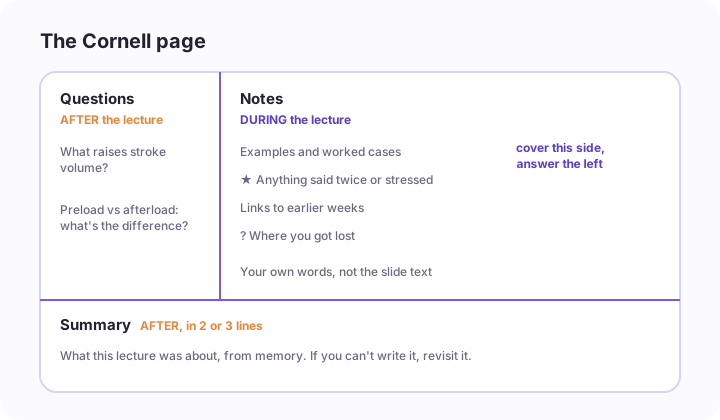
During the lecture you only write in the big right-hand space. The left column and the bottom strip stay empty until later. The research behind the exact Cornell format is thinner than its reputation, but the part that matters, turning notes into questions you answer from memory, rests on one of the most consistent findings in learning science. Why testing yourself beats rereading.
After the lecture: the 15 minutes that make the notes worth having
Do this the same day, or the next at the latest, while you still remember what your half-sentences meant.
- Fix the gaps. Fill in anything you missed from the slides or the recording. Answer your own "?" marks if you can, or note them to ask about.
- Write questions in the left column. For each chunk of notes, write a question it answers. Not "Preload" but "What happens to stroke volume when preload increases?" Questions should make you produce an answer, not recognise a word.
- Write a two or three line summary at the bottom. If you can't summarise the lecture, you've found what to revisit.
- Cover the right side and answer the questions. Out loud or on scrap paper. This is the first review, and it's the one that matters most.
From here, the questions are your revision. Come back to them a couple of days later, then about a week later, instead of rereading the notes from the top. How to space those reviews.
What this looks like in a few subjects
Nursing and medicine. Lectures are dense with lists: signs and symptoms, drug classes, nursing interventions. Don't copy the list. Write the reason behind it ("why does the patient go tachycardic?"), because the exam asks you to apply it to a patient, not recite it.
Law. Write down each case name with one line on why it matters and which test it set up. Your left-column questions become "What's the test for duty of care in X situation, and where does it come from?"
Psychology. Research methods lectures are full of terms that look alike. Write them in pairs with the difference between them, such as reliability versus validity, because exams love asking you to tell them apart.
Where an app fits (and where it doesn't)
I build The Study Mill, so I'm biased, but I'll be clear about what it does and doesn't replace. You upload the week's slides, PDFs, notes, a photo of handwritten pages, or the lecture recording, and it builds short lessons, flashcards and a quiz from that material, plus Walk & Learn, where two hosts teach the week back to you as audio and ask you questions to answer out loud.
That does the "write questions from your notes" step for you, which is the step most people skip. It doesn't replace paying attention in the room. The starred moments, your own "?" marks and the lecturer's hints are things only you catch, so it's worth uploading your own notes alongside the slides. If you'd rather work from a recording you've fallen behind on, this post covers turning a recording into notes.
The free plan covers 2 classes. Pro adds unlimited classes, exam mode and cram sheets.
Try it on one lecture
You don't need to overhaul a whole semester. Take your next lecture and try this: skim the slides first, write only what's said out loud, then spend 15 minutes that evening turning it into questions. If you'd like to compare, upload the same lecture to The Study Mill and see which set of questions catches you out more.