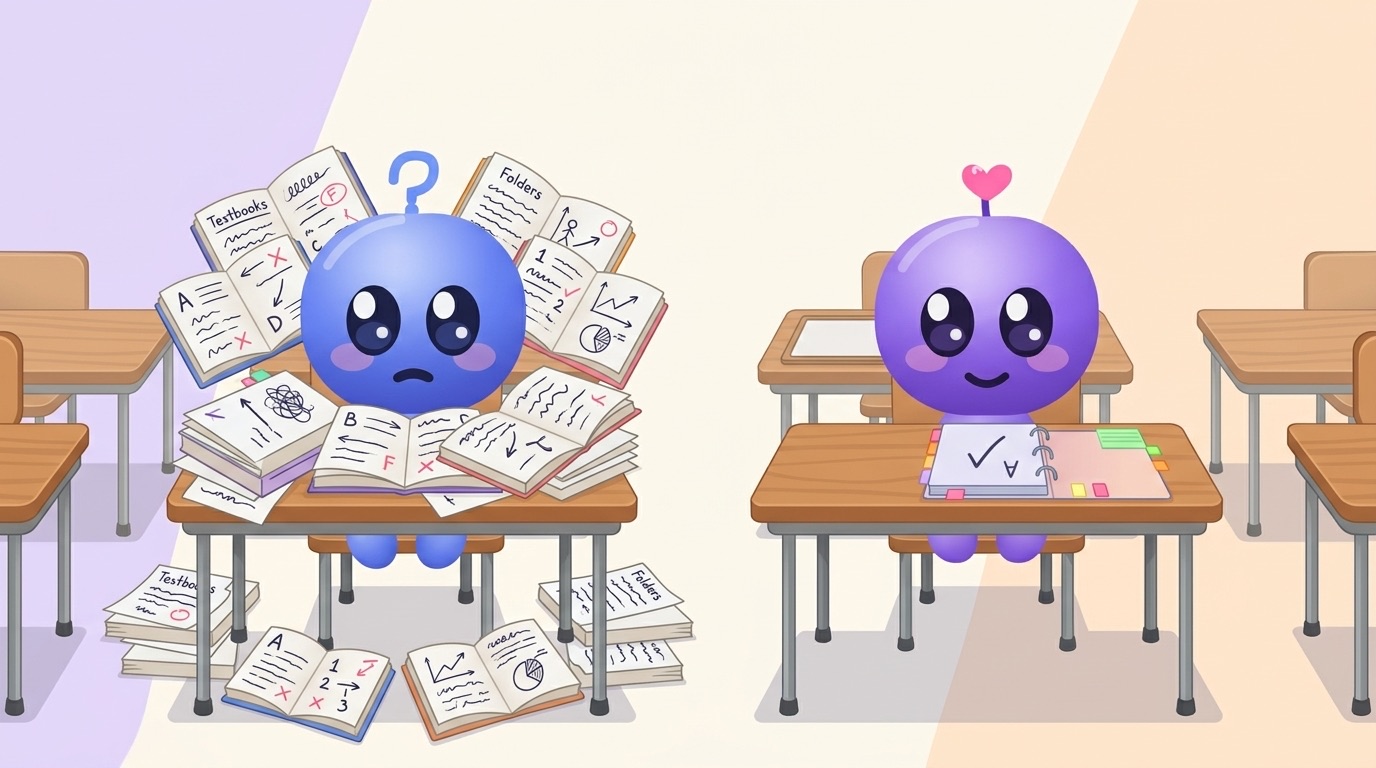
Your unit outline says the final is open book. You can bring the textbook, your lecture notes, anything printed. The relief lasts about a day, until someone who sat it last year mentions they brought two lever-arch folders and still ran out of time.
That's the trap. Open-book exams are usually harder than closed-book ones, not easier, because the examiner knows you can look up definitions, so they don't ask for them. They ask you to apply ideas to a new case, compare, or argue, under the same clock. To prepare, learn the core material as if the exam were closed book, then build a short, tabbed reference you can find anything in within about 30 seconds, and practise answering real questions with it against a timer. Your notes are a safety net for the details, not a substitute for knowing the subject.
Why "I can just look it up" goes wrong
There's a well-known line of memory research on this. In studies by Pooja Agarwal and Henry Roediger, students who were told to expect an open-book test spent less time studying than students expecting a closed-book one, and later did worse when they were tested without notes. The format itself mattered less than the expectation. Knowing you'll have your notes quietly lowers how hard you prepare.
Other studies find open-book and closed-book practice tests help memory about equally, and both beat rereading. So the notes aren't the problem. Planning to lean on them is.
In the exam room it shows up as time. Every look-up costs you: find the right folder, the right page, read the paragraph, work out how it applies. Do that for every question and you've spent a third of the exam reading. The students who do well barely open their materials. They know the content, and check one number or one case name.
What open-book questions actually ask
Because recall is free, examiners test the things notes can't do for you:
- Application. A nursing paper gives you a patient scenario and asks which assessment comes first and why. The textbook has the theory. It doesn't have this patient.
- Analysis and comparison. A psychology question asks you to critique a study design you've never seen.
- Argument. A law problem question needs you to spot the issues and run each one through the rules, which I covered in answering law problem questions with IRAC. A copied paragraph of rules earns very little.
If your notes are organised by lecture, they'll match none of these. You need them organised by the kinds of questions you'll be asked.
How to prepare, step by step
1. Sort the content into what you know cold and what you check
Go through your weeks and decide, topic by topic, which bucket each thing belongs in.
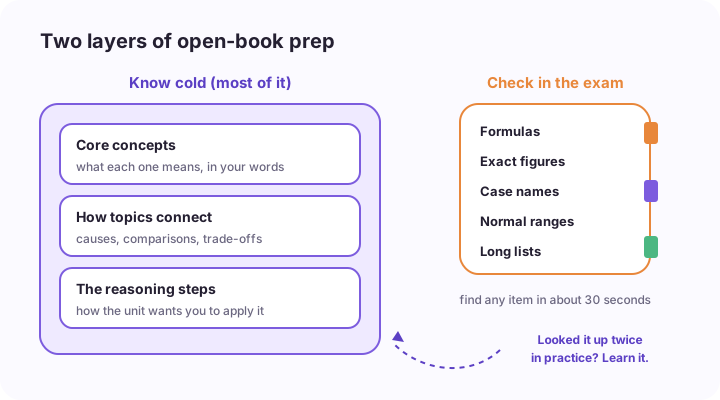
Know cold: the main concepts, how they connect, and the reasoning steps the unit keeps using. If you'd need these on most questions, they can't live in a folder.
Check in the exam: formulas you'd write out anyway, exact figures, long lists, case names, normal ranges, the wording of a legislative section. Things you understand but might misremember under stress.
Most students get this ratio backwards. The core should be the bigger pile.
2. Learn the core with retrieval, not rereading
Treat the core exactly like a closed-book exam. Test yourself on it, get things wrong, and come back to them a few days later. Rereading your notes feels productive and isn't, for the reasons in active recall vs rereading. Practice questions are the main tool here. One test of whether you're done: can you explain how a topic works to someone without looking?
3. Build a slim reference, then index it
This is where open-book prep differs. Make one document for the exam, not a stack. Write it yourself; condensing it is half the studying. Then make it findable:
- Tab it by topic, with coloured tabs for the sections you'll hit most.
- Put a one-page contents list at the front.
- Keep the details that are easy to forget (dose formulas, cut-off values, key cases with a one-line holding) on summary pages near the front.
- Add worked examples of the hardest question types, so you can follow a pattern if you blank.
If you're allowed a textbook, add tabs to it too, but only for pages you've already used in practice. A tab you've never opened is a tab you'll hunt for.
A good test: pick ten random facts from the unit and time how long it takes to find each one. If any take more than about 30 seconds, fix the index. The same idea, in miniature, is how a cram sheet works: cues that make you produce the answer, not pages to read.
4. Practise with the reference, under time
Get past papers or practice questions and sit them with your materials open and a timer running. Note every time you open the folder and why. Two things to watch:
- If you're looking up the same thing over and over, it belongs in the core. Learn it.
- If you're looking something up and can't find it, it belongs on the front pages or needs a better tab.
After two or three practice runs, your reference should be shorter, not longer.
5. Plan the exam itself
Read every question first and jot the topics and tabs you'll need beside each. Budget your time by marks. Answer in your own words; copying a passage from the textbook rarely earns marks and some units treat large copied chunks as a problem. If your exam is online, check the rules on what you can open, since "open book" doesn't always mean open internet or open AI tools.
Where The Study Mill fits
I build The Study Mill, so I'm biased, but it does the know-cold half of this well. Upload each week's slides or lecture recording and it makes short lessons, flashcards and a quiz with written answers marked by AI, all from your own material. The daily review brings back what you got wrong, which is the spacing step done for you. Set the exam date and it plans revision around your timetable. Walk & Learn turns a week into audio with questions you answer out loud, which is a good check for "can I explain this without notes?"
It won't build your tabbed binder for you, and it shouldn't. Writing that yourself is part of learning it. Pro (A$7.99 a month, or half price with a .edu or .edu.au email) adds cram sheets, which make a good starting skeleton for the front pages.
This is general study advice. Your unit outline and exam instructions decide what you're allowed to bring and use, so check them first.
Try it on one week
Take one week of your unit and do the sort from step 1 on paper: what you'd need to know cold, and what you'd only check. Then quiz yourself on the first list. If you'd rather have the questions written from your own slides, upload that week to The Study Mill. The free plan covers two classes.