
You open the exam and there's a page about Priya, who slipped on a wet floor at a café, and the café's owner, who says the sign was right there. Advise Priya. You know negligence. You can name the cases. Forty minutes later you've written three pages, and when the marks come back the comment says "describes the law but doesn't apply it".
That comment is the most common one on law problem answers, and IRAC exists to stop it. IRAC stands for Issue, Rule, Application, Conclusion. For each legal issue in the facts, you name the issue, state the rule that governs it, apply that rule to these particular facts, and reach a conclusion on that issue. Then you move to the next issue and do it again. Most marks sit in the application, so that's where most of your words should go.
What each letter actually asks for
Issue. A specific legal question raised by the facts, phrased as a question. Not "negligence" but "Did the café owe Priya a duty of care?" and then, separately, "Did it breach that duty?" A good issue names the parties and the point in dispute.
Rule. The law that answers the question: the legal test, the statutory provision, and the case or two that set it out. State it briefly and accurately. You're not writing the history of the doctrine. One or two sentences, with authority, is usually enough.
Application. This is the answer. Take each element of the rule and match it against the facts you were given. Which facts point one way? Which point the other? What would each side argue? If the café had a sign up, is that enough to make the risk obvious, and does it matter that the floor had been wet for an hour? Use the facts by name. Markers reward you for noticing details the examiner planted on purpose.
Conclusion. A direct answer to the issue you raised, with a sense of how strong it is. "Priya is likely to establish breach" is a conclusion. "It depends" on its own is not. You're allowed to be uncertain, but you have to commit to which way it probably falls and why.
One IRAC per issue, not one for the whole answer
The single biggest structural mistake is treating IRAC as four sections for the whole answer. You write every rule you know in one block, then a long paragraph of facts, then a conclusion. It reads like it follows the method. It doesn't, because the rules and the facts never meet.
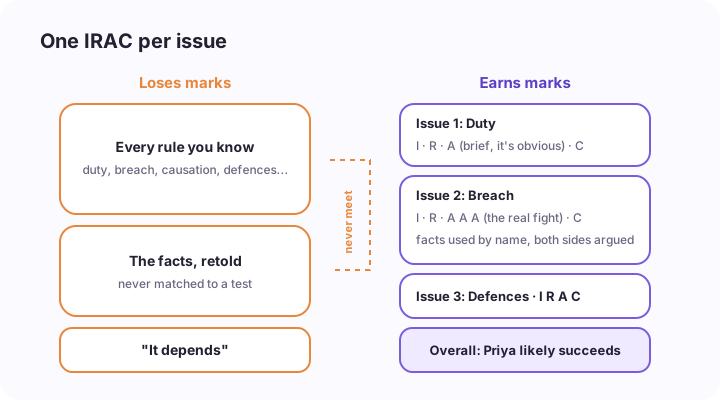
A strong answer runs a small IRAC for each issue, in a sensible order, and finishes with a short overall conclusion that pulls the issue conclusions together. In negligence that might mean separate passes for duty, breach, causation, any defences and damages. In contract it might be offer, acceptance, consideration and intention, then whether a term was breached.
Not every issue deserves the same space. If duty is obvious (a café and its customer), say so in two lines with authority and move on. Spend your time where the facts are arguable. Examiners write problem questions so that one or two issues are the real fight.
Where the marks usually go missing
- Rule dumping. Writing everything you know about a doctrine, including the parts the facts don't raise. It costs time and earns little, because marks are for using the law, not reciting it.
- Application that just repeats the facts. "The floor was wet and Priya slipped" isn't application. Application says why that fact matters under the rule: "Because the owner knew the floor had been mopped an hour earlier, a reasonable person in their position would have taken more than a single sign as a precaution."
- Only arguing one side. Your client's case is stronger if you've dealt with the other side's best point. Raise the counterargument, then say why it probably fails (or might succeed).
- Missing issues. Planted facts are clues. If the question mentions that Priya was looking at her phone, contributory negligence is on the table. If it mentions a date, a limitation period or a statutory change might be.
- Not answering the question asked. "Advise Priya" means advise Priya. "Discuss the liability of all parties" means everyone. Read the last line of the question first.
The variations are the same idea
Depending on your law school you'll see different acronyms. ILAC (Issue, Law, Application, Conclusion) swaps Rule for Law. Monash teaches MIRAT, which starts with the material facts and ends with a tentative conclusion. CREAC, used in some US legal writing, puts the conclusion first. They all ask for the same thing: find the issue, state the law, apply it to these facts, answer. Use whichever one your unit's marking guide uses, because that's the language your marker will be looking for.
This is general study advice, not official guidance. Your unit outline and marking rubric are the final word on how answers are assessed.
How to practise it before the exam
IRAC is a skill, and skills come from doing the thing, not from reading model answers.
Turn your notes into rule statements. For each topic, write the elements of each test as a short list with the leading case next to each element. That's the "R" you'll need in the exam, already trimmed. If your lecture notes are a wall of case summaries, this is how I'd restructure them.
Practise issue spotting on its own. Take a problem question and give yourself five minutes to list every issue, nothing else. Then check against the model answer or your tutor's notes. Spotting is a separate skill from writing, and it's quick to drill.
Write full answers under time. Tutorial problems and past exams are the best material you have, because they come from the people who set your exam. Practice questions and past papers do different jobs, and for law the past papers are worth protecting for timed runs.
Explain the rule out loud without notes. If you can't state the test for breach of duty from memory in plain words, you'll struggle to apply it under pressure. Saying it aloud shows you quickly where you're vague. The Feynman technique is a good way to structure this.
Where The Study Mill fits
I build The Study Mill, so I'm biased. It helps with the "R" more than the "A". You upload your own lecture slides, readings or recordings, organised by class and week, and each week becomes short lessons, flashcards for the elements and leading cases, notes, and a quiz that mixes multiple choice with written answers marked by AI. The written answers are useful for rule statements: you explain a test in your own words, and it tells you which element you left out. Everything is built only from what you uploaded, so it follows your unit's cases, not some other jurisdiction's.
To be fair about the limits: it won't write you a full hypothetical and mark a forty-minute problem answer the way your tutor will. For application, nothing beats writing answers to real problem questions and getting feedback from someone who marks them. The free plan covers two classes; Pro adds exam mode and cram sheets.
If you want to try it, upload one week of torts or contract and see whether you can state every test it asks you about without looking.