
A doctor orders 1 g of paracetamol. The tablets on the shelf are 500 mg. Most nursing students get that one right in their head. Then the medication maths test arrives with micrograms, millilitres per hour, a drop factor and a child's weight, and suddenly the same person writes down 0.02 tablets.
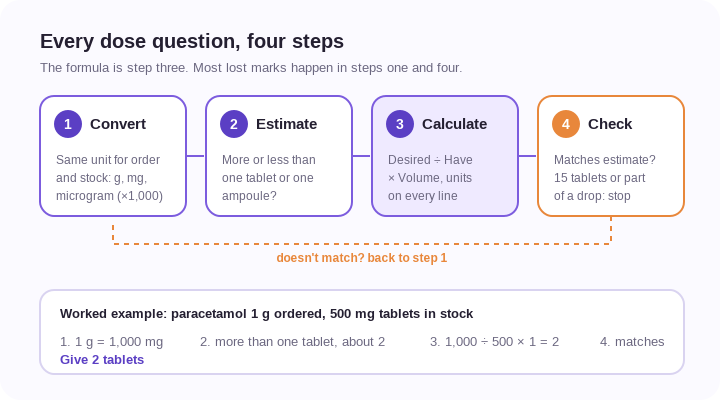
The good news is that almost every question in a nursing drug calculations test is one of four formulas: tablets and liquids, IV rate in mL per hour, drops per minute, and weight-based doses. The marks are rarely lost on the formula. They're lost on units (grams against milligrams, hours against minutes), on decimal points, and on not stopping to ask whether the answer is sensible. Learn the four formulas, convert units before you start, and estimate the answer first, and you'll catch most errors before they cost you.
That matters more than usual here. Many Australian nursing programs require 100% on medication calculation assessments, often with more than one attempt allowed, so one slip can mean a resit. Check your own unit outline for the exact rules, including whether a calculator is allowed.
Formula 1: tablets, liquids and injections
The classic is "what you want, over what you've got, times what it's in":
Dose = (Desired ÷ Have) × Volume
- Desired: the dose ordered.
- Have: the strength of the stock.
- Volume: what that stock strength comes in (1 tablet, 5 mL, 1 mL).
Paracetamol 1 g ordered, 500 mg tablets in stock. Convert first: 1 g is 1,000 mg. Then 1,000 ÷ 500 × 1 tablet = 2 tablets.
An oral liquid: 375 mg ordered, stock is 250 mg in 5 mL. 375 ÷ 250 × 5 = 7.5 mL.
An injection: 7.5 mg ordered, stock is 10 mg in 1 mL. 7.5 ÷ 10 × 1 = 0.75 mL. Notice the answer is less than the full ampoule, because you want less than the ampoule holds. That kind of quick check is the habit that saves you.
Formula 2: IV rate in mL per hour
For pumps, you want volume over time, with time in hours:
Rate (mL/hr) = Volume (mL) ÷ Time (hours)
1,000 mL over 8 hours is 125 mL/hr. If the order is in minutes, convert to hours first: 100 mL over 30 minutes is 100 ÷ 0.5 = 200 mL/hr. Students who divide by 30 here get 3.3 mL/hr, which would take over a day to run through.
Formula 3: drops per minute
When there's no pump and you're counting drops on a gravity line, the drop factor on the giving set packet joins the formula, and time moves to minutes:
Drops/min = (Volume (mL) × Drop factor (drops/mL)) ÷ Time (minutes)
1,000 mL over 8 hours on a 20 drops/mL set: 1,000 × 20 = 20,000, and 8 hours is 480 minutes. 20,000 ÷ 480 = 41.7, which rounds to 42 drops per minute. You can't count part of a drop, so round to a whole number at the end, not halfway through.
A handy check: on a 60 drops/mL microdrip set, drops per minute equals mL per hour, because the 60s cancel. If a question uses a microdrip set and your two answers don't match, something has gone wrong. Always take the drop factor from the question (or, on the ward, from the packet). Don't assume one.
Formula 4: weight-based doses
Common in paediatrics and with some high-risk drugs:
Dose = Dose per kg × Weight (kg)
A drug ordered at 15 mg/kg for a 22 kg child is 15 × 22 = 330 mg. If it comes as a liquid of 120 mg in 5 mL, you go back to Formula 1: 330 ÷ 120 × 5 = 13.75 mL.
Two traps live here. Questions sometimes give the weight in grams (for a neonate) or say "per dose" against "per day, in divided doses". Read the order twice. If the daily dose is split into four, divide by four before you work out the volume.
The mistakes that cost marks
These are the errors markers see over and over, and none of them are about not knowing the formula.
Mixing units. Grams, milligrams and micrograms each step by 1,000. Convert the order and the stock into the same unit before you touch the formula. Most people find converting to the smaller unit (so you're working with whole numbers) causes fewer errors.
Misplacing a decimal. A slipped decimal point makes a tenfold error, which is the classic dangerous medication mistake. Always write a leading zero (0.5 mg, not .5 mg) and never a trailing zero (5 mg, not 5.0 mg, which can be read as 50). Australian national guidance on medication terminology flags trailing zeros and the µ symbol as error-prone, so write "microgram" in full if you're unsure.
Flipping the fraction. Putting what you have over what you want gives an answer that looks plausible and is upside down. Saying "want over got" out loud is silly and it works.
Hours versus minutes. Formula 2 wants hours, Formula 3 wants minutes. Write the unit next to every number on every line and the mismatch jumps out.
Rounding too early. Keep the full number until the last step, then round as the question asks.
Not sanity-checking. If your answer is 15 tablets, a fraction of a drop, or an infusion that takes three days, stop. Real doses are usually one or two tablets, or a sensible volume. Estimate before you calculate, then compare.
How to practise so it holds up on test day
Reading worked examples feels productive and does very little. Calculation is a skill, so practise it the way you'd practise anything you need to do under pressure.
- Do lots of short sets, often. Ten questions a day for two weeks beats a hundred the night before. Spaced practice is one of the most reliable findings in learning research.
- Mix the question types. If every question on a page is drops per minute, you never practise spotting which formula a question needs, which is half the test. Mixing topics feels harder and works better, as I explain in interleaving: why mixing topics works.
- Keep an error log by mistake type, not by question. After a week you'll see your own pattern, and you can drill that specifically.
- Practise in test conditions. Same calculator rules, same time limit, written working, units on every line.
If you're also learning the drugs themselves, start with how to memorise drug names by their endings. Calculations and pharmacology knowledge meet in questions like "this dose is ordered, is it safe to give?", which is close to the judgement style covered in how to answer NCLEX-style questions.
Where The Study Mill fits (and where it doesn't)
I build The Study Mill, so weigh this accordingly. If your pharmacology or medication safety lectures come as slides, upload the week and it writes short lessons, flashcards and a quiz from those slides, so the formulas, abbreviations and safety rules match what your lecturer taught. The quiz mixes multiple choice with written answers marked by AI, which suits "explain why this order needs clarifying" questions, and anything you miss comes back in daily review. The free plan covers 2 classes.
For raw calculation drill, though, it's not the best tool. You want hundreds of questions with the numbers changed each time, and your university's medication calculation practice platform or your textbook's question bank will do that better. Use those for the reps and use your slides for understanding why the rules exist.
If you only do one thing this week, take ten practice questions, write the units beside every number, and estimate each answer before you calculate it. Then try putting one medication safety lecture through The Study Mill and see what it quizzes you on.
This is general study advice, not clinical guidance. Always follow your course materials, your unit's assessment rules and your health service's medication policies, and check doses against an approved reference such as the Australian Medicines Handbook.