Picture the card. On the front: "Heart failure". On the back: eleven bullet points covering causes, left versus right sided signs, three drug classes and a note about daily weights. You flip it, read the back, nod, and mark it "got it". You didn't get it. You recognised it.
A good flashcard asks one clear question that has one short answer, written in your own words, and you can say the answer out loud before you flip. That's most of it. Cards built that way are quick to review, honest about what you know, and easy for spaced repetition to schedule. The rest of this post is the detail: how to split big ideas, what to do with lists, and where people go wrong.
Rule 1: understand it before you card it
Flashcards are for remembering things you already understand. They are a poor way to learn something for the first time. If you make a card for "preload" before you know what preload is, you'll memorise a string of words and lose it the moment the exam phrases the question differently.
This is also the first rule in Piotr Wozniak's well known essay on formulating knowledge (he created SuperMemo, the program whose early scheduling ideas Anki later borrowed). Read the lecture, watch the explanation, ask someone. Then make the card.
Rule 2: one idea per card
This is the rule that does the most work. Wozniak called it the minimum information principle: make each card as simple as you can. A small card is easy to recall in one go, so when you get it wrong you know exactly what you didn't know. A big card fails for a dozen different reasons and you never find out which one.
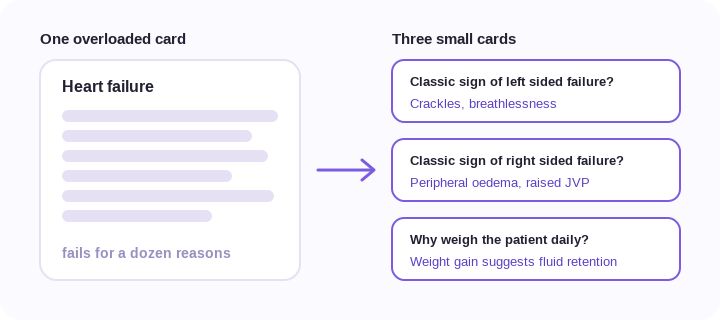
Take that heart failure card. Split it:
- What's the classic sign of left sided heart failure? Pulmonary congestion: crackles and breathlessness.
- What's the classic sign of right sided heart failure? Peripheral oedema and a raised JVP.
- Why weigh a heart failure patient daily? A quick gain in weight suggests fluid retention.
(The clinical examples here are for practising card writing, not clinical guidance. Your course materials are the source to follow.)
Three cards instead of one. More cards feels like more work, but each takes a couple of seconds, and you'll stop marking things "got it" that you didn't.
A quick test from our guide to AI flashcard makers: if you can't say the answer in one breath, split the card.
Rule 3: the front should be a question
"Operant conditioning" on the front and a definition on the back is a vocabulary card. It only works one way, and it trains you to recite. Make the front something you have to answer:
- Weak: Negative reinforcement
- Better: A behaviour increases because something unpleasant is removed. What's that called?
The better card also tackles the classic psychology trap, mixing up negative reinforcement with punishment, because the question forces you to think about what's happening rather than match a label.
For things that matter both ways (a drug name and its class, a term and its meaning), make two cards, one in each direction. Wozniak's rules say redundancy like this is fine. Knowing that metoprolol is a beta blocker doesn't mean you can name a beta blocker when asked.
Rule 4: break up lists
Lists are where flashcards die. "List the twelve cranial nerves in order" asks you to recall a whole set at once, in order, and one slip makes the card a fail.
Better options:
- One card per item, with context. "In the nursing process (ADPIE), what comes after Assessment?" Each card is small and the acronym does the ordering for you.
- Cloze deletion. Take a sentence from your notes and blank out one word: "The ___ nerve supplies the diaphragm." Anki has this built in. It's ideal for dense, fact heavy material.
- Ask about the difference, not the set. Instead of listing every type of shock, ask "What makes septic shock different from hypovolaemic shock?"
If your exam really does require you to reproduce a list (some anatomy and law courses do), learn it with a mnemonic first, then card the mnemonic and each item separately.
Rule 5: use your own words, and your lecturer's terms
There's decent research behind making your own cards. A 2022 series of experiments by Steven Pan and colleagues found that students who made their own flashcards remembered more than students given ready-made ones, and that paraphrasing into your own words was what helped. Copying sentences word for word from the slides did much less. Not every study agrees: other researchers found no benefit, partly because making cards eats into the time you'd spend reviewing them.
My reading of it: the benefit comes from thinking about the material, not from the typing. So whoever writes the first draft, read each card and rewrite anything that doesn't sound like you.
The exception is terminology. If your lecturer says "ADPIE" or "the duty of care", keep that exact phrase. The exam will use it.
Rule 6: add a picture when the idea is visual
Some things are easier to remember as a picture: the flow through the heart, the Krebs cycle, the brachial plexus, a supply and demand shift. A small labelled diagram on the back of a card is worth more than a paragraph describing it. Pairing words with a simple image is a well established memory aid. Keep it simple, though. A busy screenshot of a whole slide is just a crowded card in disguise.
Rule 7: delete freely
A deck isn't a trophy. If a card is trivial, badly worded or something you'll never be asked, delete it. If you keep missing a card for weeks, the card is usually the problem, not you. Go back to the explanation, then rewrite it smaller.
And cards only work if you see them again at the right times. Good cards plus a simple spaced repetition schedule beats a beautiful deck you review once.
Quick checklist
| Check | If it fails |
|---|---|
| I understood this before carding it | Go back to the lecture first |
| One idea, one-breath answer | Split it |
| The front is a question | Rewrite as a question |
| No lists of more than two or three items | Cloze it or card each item |
| Sounds like me, uses my lecturer's terms | Rewrite in your words |
| I'd actually be asked this | Delete it |
Where The Study Mill fits
I build The Study Mill, so I'm biased. When you upload a week's slides, notes or a lecture recording, it writes flashcards from that material following these rules: short questions, one idea each, your lecturer's terms. Each card links back to the lesson it came from, so a card you keep missing takes you to the explanation rather than leaving you to grind it. Where a picture helps, some cards come illustrated.
It doesn't replace the thinking. I'd still read through the set and rewrite or delete anything that doesn't feel like yours, which is where that research says the benefit lives. If you'd rather build every card by hand, Anki is excellent and far more customisable than we are. Quizlet vs Anki covers that choice.
Flashcards are also only one kind of practice. For anything you need to explain rather than recall, written questions test you better than cards can. Why recall beats rereading.
Try it on one lecture: upload it, look at the cards it makes, and run them past the checklist above.