
In a lot of first-year maths units, week two is limits, week three is the derivative from first principles, and by week four the lecturer is running through the product, quotient and chain rules in one fifty-minute session. Each example looks fine while it's on the screen. Then the tutorial sheet arrives and the first question uses all three rules at once.
The way to study calculus when the lectures move too fast is to stop trying to keep up by watching, and keep up by doing: fix any shaky algebra first, learn what a derivative and an integral mean as pictures, then work a few problems from a blank page every day, mixing types once you know them. Catching up in week ten is far harder than staying level in week three, because every new topic leans on the last one.
This is general study advice. Your unit outline decides what's assessed, and your lecturer's notation and methods are the ones to match.
Why calculus feels fast even when it isn't
Calculus is cumulative in a way most subjects aren't. In a psychology unit, missing week four hurts week four. In calculus, if the chain rule didn't land, integration by substitution in week eight won't either, because substitution is the chain rule run backwards.
Lectures also show you finished work, so every step looks obvious. Following someone else's working feels like understanding, but it's recognition, not production. I wrote about why that feeling fools almost everyone in active recall vs rereading. In calculus the gap shows up the moment you face a blank page.
Fix the algebra before the calculus
Here's something many first-years don't expect: plenty of marks in calculus are lost on algebra, not calculus. You get the derivative right and then slip on a negative sign, mishandle a fraction or forget an index law while simplifying.
Research on first-year calculus points the same way. Studies of who succeeds in uni calculus have generally found that being solid on the prerequisites (algebra, functions, trigonometry) matters more than whether you took calculus at school. Some researchers also argue that conceptual understanding matters as much as algebra skill, which is why the next section exists.
So if your algebra wobbles, spend a week shoring it up alongside the lectures. The usual suspects are index laws (especially negative and fractional powers), factorising, simplifying algebraic fractions, log and exponential laws, and the standard trig identities and exact values. Your uni's maths learning centre will usually have free refresher material.
Learn what the symbols mean, not just the rules
You can pass early quizzes by memorising rules. You can't do the applied questions (rates of change, optimisation, area) without knowing what the rules are for.
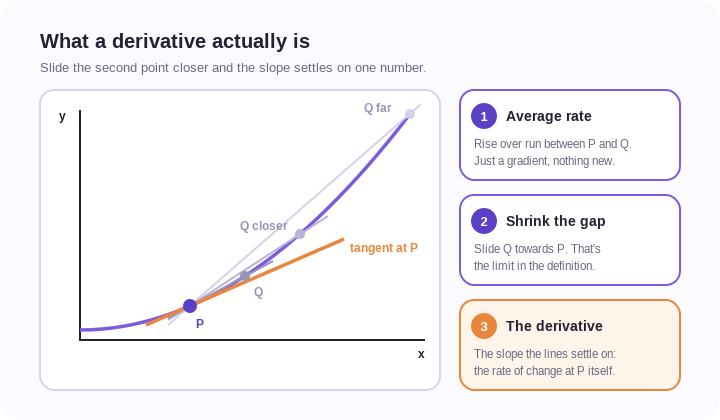
A derivative is a rate of change: how fast one thing changes as another changes. Graphically, it's the slope of the curve at a single point. You already know how to find the slope between two points: rise over run. The derivative is what that slope settles on as you slide the second point closer and closer to the first. That's all the limit in the first principles definition is doing.
An integral runs the other way. It adds up lots of thin slices to find a total, such as the area under a curve, or the distance travelled from a velocity graph. The fundamental theorem of calculus is the link: differentiation and integration undo each other.
If you can explain those two ideas in plain words with a sketch, the formal definitions stop looking like noise. The Feynman technique is a good way to test yourself on this. For visual explanations, 3Blue1Brown's free Essence of Calculus video series is excellent at the "why", and Khan Academy and Paul's Online Math Notes are good for extra worked examples at your own pace.
Do problems the right way
Learning research has a well established finding called the worked example effect. Beginners learn more from studying a worked example and then solving a similar problem themselves than from jumping straight into problems alone. The support works best when it fades: first copy the method, then try one with the solution covered, then one with no example in sight.
In practice that looks like this:
- Read one worked example from the lecture or textbook until you can say why each step happens.
- Cover it and redo the same question from a blank page.
- Do two or three similar questions from the tutorial sheet or textbook exercises.
- Check each answer properly. Wolfram Alpha or Symbolab can confirm a final answer, but compare your working line by line with a worked solution where you have one.
Show every line of working, even in practice. Markers in most units give method marks, and written working is where you'll find your own errors.
Learn to pick the right tool
Doing ten chain rule questions in a row teaches you the chain rule. It doesn't teach you to look at an unfamiliar function and decide whether it needs the chain rule, the product rule or both. On the exam, choosing the method is often the hardest part.
That's what interleaving trains. Classroom studies with maths students, including large trials run by Doug Rohrer and colleagues, have generally found that mixing problem types in practice sets leads to better scores on later tests than practising one type at a time, even though mixed practice feels harder while you're doing it. More on why in interleaving.
So once you've met a few techniques, build mixed sets. Shuffle differentiation questions from weeks three to six, or integration questions that need substitution, parts or neither. Before you start each one, write down which method you'll use and why.
Keep an error log
Every time you get a question wrong, write a line in a notebook: the question, what went wrong, and what you'll do differently. "Forgot the chain rule on the inside function." "Dropped the negative when differentiating cos." "Didn't add + C."
After a few weeks, patterns show up, because most of us repeat the same few mistakes. Fixing those is often worth more marks than learning anything new, and the log becomes your best revision sheet before the exam.
A weekly rhythm that keeps you level
When lectures feel too fast, a steady routine beats one heroic weekend. Something like:
- Before the lecture: skim the slides for ten minutes so nothing is brand new.
- Same day as the lecture: do two or three basic questions on the new topic while it's fresh.
- Before the tutorial: attempt the whole sheet, and mark exactly where you got stuck so you can ask about it.
- Once a week: do a short mixed set from all earlier topics, and go through your error log.
When the exam gets closer, move to past papers under time. I've compared when to use which in practice questions vs past papers.
Where The Study Mill fits
I build The Study Mill, so I'm biased, and I'll be straight about the limits here. The heart of studying calculus is working problems on paper, and no app should replace that. Your pen, your tutorial sheets and your textbook exercises do the heavy lifting.
Where it helps is the understanding around the working. You upload your calculus slides, notes, PDFs or lecture recordings, organised by class and week, and each week becomes short lessons with analogies, flashcards, notes, a tutor you can ask, and a quiz that mixes multiple choice with written answers marked by AI. Because it's built from your own material, the questions use your lecturer's examples. It's useful for the conceptual side: what a derivative represents, when to reach for which rule, what the fundamental theorem says. Daily review brings back what you missed. The free plan covers two classes; Pro adds unlimited classes, exam mode and cram sheets.
If you want to try it, upload the week your lectures started to lose you, and see whether you can explain the main idea in your own words before you open the tutorial sheet.