
Three essays, three hours. You start the first one feeling good, write four pages, and look up to find you've used 80 minutes. The second essay gets 55. The third gets a rushed plan and two paragraphs, and that third essay is worth exactly as much as the first.
Most students who struggle with exam essays don't have a knowledge problem. They have a time and structure problem. To write a good essay under time pressure, split your time by the marks before you start, spend the first five to eight minutes of each essay planning, put your direct answer to the question in the first two sentences, and give every body paragraph one point that links back to that answer. Then practise exactly that, with a timer, before the exam. A shorter essay that answers the question beats a long one that circles it.
Budget your time by marks, before you write a word
Marks are the exchange rate. Take the total time, take off a few minutes for reading the paper and a few for checking at the end, and divide what's left by the total marks. Multiply by each question's marks and write the finishing time next to each question on the paper. University study guides suggest this almost word for word, and it works because it turns a vague worry ("am I going too slow?") into a number you can check.
In a three-hour paper with three equal essays, that's roughly 50 to 55 minutes each. When the time for an essay runs out, finish the sentence, write a one-line conclusion, and move on. You'll pick up far more marks starting the next essay than you will polishing the fourth page of this one. If there's time at the end, come back.
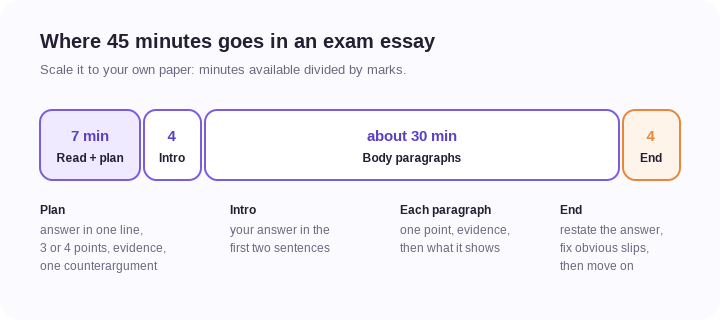
Plan for five to eight minutes (it feels like wasting time, it isn't)
Planning is the step people skip when they panic, and it's the one that saves the most marks. A plan isn't a mini essay. It's a few lines on the back of the booklet:
- Your answer in one sentence. If the question asks "To what extent was X the main cause of Y?", write how far you agree. That sentence becomes your thesis.
- Three or four points that support it, in order, each a few words long.
- The evidence for each point: the study, case, statistic from your lectures or example you'll use.
- The strongest counterargument, and one line on why your answer still holds (or how far it holds).
Underline the instruction word in the question while you plan. "Evaluate", "compare", "discuss" and "explain" ask for different essays. A psychology question that says "evaluate" wants strengths and weaknesses of the theory, not a description of it. Describing when you were asked to evaluate is one of the most common reasons good students get average marks.
Put the answer in the first two sentences
Markers read a lot of scripts. An introduction that spends a paragraph on background ("Since the dawn of time, humans have...") makes them hunt for your argument. Instead, answer the question straight away, using the key words from the question, then say briefly how the essay will get there.
A nursing example: "Patient education is the most important factor in reducing hospital readmissions for heart failure, because most readmissions follow lapses in medication and fluid management at home. This essay considers medication adherence, symptom monitoring and follow-up, and argues that each depends on what the patient understood at discharge."
Two sentences. The marker knows your position and your route. Everything after that is evidence.
One point per paragraph, linked back every time
Each body paragraph should open with a sentence that makes one point and connects it to your thesis. Then give the evidence. Then explain what the evidence shows, in your own words. That last part is the one people drop under pressure, and it's where the analysis marks are.
A quick test for any paragraph: if you covered everything except the first sentence, would the marker still know why the paragraph is there? If the first sentence is "Another factor is discharge planning", the answer is no. If it's "Discharge planning only works when it changes what patients do at home", the answer is yes.
If you've written law problem answers, this will feel familiar. The same habit that makes IRAC work for problem questions applies here: the marks are for using what you know on the question in front of you, not for reciting it.
When you're running out of time
It happens, even with a plan. When it does:
- Switch to dot points for the last section. A clear list of your remaining points and their evidence earns more than nothing, and many markers will give partial credit for it. Check your unit's rules, because some don't.
- Always write a conclusion, even if it's two lines restating your answer. An essay without one reads as unfinished.
- Don't start crossing out and rewriting. Add a short correction instead. Rewriting costs time you don't have.
And if your mind goes blank halfway through, go back to your plan. That's partly what it's for. I wrote more about what to do when you freeze in an exam.
How to practise before the exam
Reading model essays helps a bit. Writing timed essays helps a lot more.
Write plans, not full essays, most of the time. Take a past paper and write a plan for every essay question in eight minutes each. You'll cover far more questions this way, and planning is the skill that breaks first under pressure.
Do at least two full essays under real time. Same length, same timer, by hand if the exam is handwritten. Your handwriting speed is a fact you need to know before the day, not on it. Past papers are worth saving for exactly this.
Learn your evidence so you can recall it without notes. In an exam you can only use what you can bring to mind quickly. Testing yourself on key studies, cases and examples (rather than rereading your notes) is one of the most reliable findings in learning research, and it's what lets you write fluently instead of stalling on a name.
This is general study advice. Your unit outline and marking rubric are the final word on what your markers want.
Where The Study Mill fits
I build The Study Mill, so I'm biased. It helps with the evidence side, not the essay itself. You upload your own lecture slides, readings or recordings, organised by class and week, and each week becomes short lessons, flashcards, notes and a quiz with written answers marked by AI. Those written answers are a decent way to practise explaining one point clearly in a few sentences, which is what a good paragraph is. Daily review brings back the questions you missed, so the studies and cases you keep forgetting come round again before the exam.
To be fair about the limits: it won't set you a full essay question and mark a 50-minute answer the way your tutor will. For that, write timed essays and get feedback from someone who marks them. The free plan covers two classes; Pro adds exam mode and cram sheets, and a cram sheet is handy for the evidence list you're trying to hold in your head.
If you want to try it, upload one week of lectures and see how many of the key examples you can explain without looking.